
Reading time: ~28 minutes | Last updated: June 2026
Quick Answer: Sports betting strategy is the difference between the 3–5% of bettors who profit long-term and the 95% who don’t. The gap isn’t sporting knowledge — it’s understanding what actually separates profitable bets from unprofitable ones. That separation is not about picking winners. It’s about finding odds that are wrong relative to the true probability of an outcome — and backing those mispriced odds consistently, with correct stake sizing, over a large enough sample. This guide explains every element of that framework.
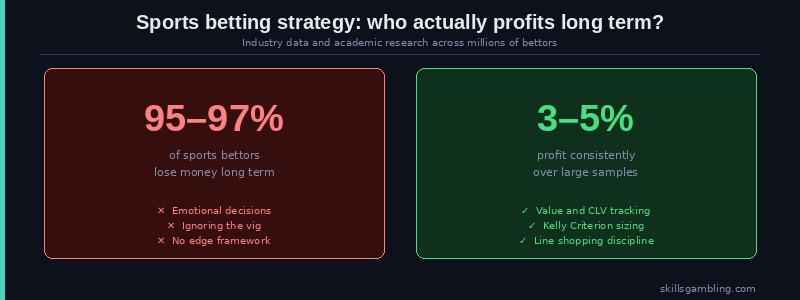
Table of Contents
- Why Most Sports Bettors Lose — and Why Some Don’t
- How Bookmaker Odds Actually Work
- What Value Betting Actually Means
- Expected Value: The Mathematics of Every Bet
- Closing Line Value: The Real Measure of Betting Skill
- How to Find Value in Sports Betting Markets
- Line Shopping: The Free Edge Most Bettors Ignore
- Kelly Criterion: Optimal Stake Sizing
- Bankroll Management for Sports Bettors
- The Skill vs Luck Question in Sports Betting
- Bet Types Explained: Which Carry the Most Edge Opportunity
- Common Sports Betting Mistakes
- Account Management: Staying in Action
- The Mental Game: Process Over Results
- Responsible Gambling
- FAQ
- Conclusion
Why Most Sports Bettors Lose — and Why Some Don’t
The mathematics of sports betting profitability are sobering. Industry data and academic research consistently find that only 3–5% of sports bettors profit over the long term. The remaining 95–97% lose money — not occasionally, but systematically and predictably.
This isn’t primarily because most bettors are bad at predicting sports outcomes. Plenty of recreational bettors have genuine sporting knowledge and pick winners more than half the time. They still lose. The reason is structural: the bookmaker’s margin (the “vig” or “juice”) means that winning half your bets at standard pricing is not a breakeven proposition. It’s a losing one.
At the standard American sportsbook price of −110 on both sides of a spread bet, you must win 52.38% of bets just to break even. That’s before any analysis of whether you have an actual edge.
“Most bettors lose not because they’re wrong about sport — but because they don’t understand the difference between picking likely winners and finding bets with positive expected value.”
The 3–5% who profit long-term share specific characteristics that have nothing to do with luck or superior sporting knowledge:
- They understand and calculate expected value on every bet
- They measure their performance by the quality of their prices, not win/loss record
- They manage stakes mathematically rather than emotionally
- They treat sports betting as a probabilistic exercise, not a prediction contest
- They shop for the best available odds across multiple bookmakers
- They accept variance as a normal feature of their activity, not a signal to change strategy
Every section of this guide addresses one of those characteristics. Together, they form the sports betting strategy framework that distinguishes the 3–5% from everyone else.
How Bookmaker Odds Actually Work
Understanding how bookmakers price markets is not optional background knowledge. It is the foundational skill that everything else builds on.
The Overround
Bookmakers do not offer fair-value odds. Every market they price contains a margin — called the overround or vig — that ensures they profit regardless of which outcome occurs.
Here’s how it works. In a perfectly fair market, the implied probabilities of all outcomes sum to 100%. Bookmakers inflate those probabilities to sum above 100%, and the excess is their margin.
Example — Premier League match:
| Outcome | Bookmaker Odds | Implied Probability |
|---|---|---|
| Home win | 2.10 | 47.6% |
| Draw | 3.40 | 29.4% |
| Away win | 3.80 | 26.3% |
| Total | 103.3% |
The implied probabilities sum to 103.3%. The excess 3.3% is the bookmaker’s margin on this market. Every pound staked on this match, across all three outcomes, returns an expected 96.7p to bettors collectively.
That 3.3% is not a house edge in the blackjack sense — it’s variable by market and bookmaker, ranging from roughly 2–12% depending on the sport, market size, and operator. Major football markets at sharp bookmakers carry margins as low as 2–3%. Novelty markets, parlays, and less-liquid sports can carry margins of 8–15%.
The margin is the cost of betting. Before you can profit, your edge must exceed the margin on every market you bet.
Sharp vs Soft Bookmakers
Not all bookmakers are equal. The distinction between sharp and soft bookmakers matters enormously for serious bettors.
Sharp bookmakers (Pinnacle, Circa, Bookmaker.eu) price markets using sophisticated models, accept large bets, and adjust lines rapidly when sharp money moves them. Their lines are highly efficient — close to the true probability of outcomes. They welcome winning bettors because sharp bettors help them refine their prices.
Soft bookmakers (most retail sportsbooks and online operators) carry higher margins, limit winning accounts, and are slower to react to market information. Their lines contain more inefficiencies — more opportunities for value — but they actively restrict bettors who exploit those inefficiencies.
This creates an uncomfortable dynamic: the books where value is easiest to find are the ones most likely to limit you when you find it consistently.
What Value Betting Actually Means
Value betting is the only framework that produces long-term profitability in sports betting. It is worth being precise about what it means because it is widely misunderstood.
A value bet exists when your estimated probability of an outcome is higher than the probability implied by the bookmaker’s odds.
That definition contains two distinct requirements:
- You must form an accurate independent probability estimate for the outcome
- The bookmaker’s implied probability must be lower than your estimate
Both are necessary. A bet is not a value bet simply because you think the team will win. It’s a value bet only if the price offered is better than the true likelihood warrants.
Worked example:
You assess a team has a 55% probability of winning a match. The bookmaker offers odds of 2.05 (implied probability: 48.8%). Your estimate exceeds the implied probability by 6.2 percentage points.
Expected value per £100 staked:
EV = (0.55 × £105 profit) − (0.45 × £100 stake) = £57.75 − £45.00 = +£12.75
For every £100 staked on this bet, you expect to profit £12.75 on average — if your probability estimate is correct.
That “if” is doing enormous work. The entire framework rests on the quality of your probability estimates. Overconfident or biased estimates produce negative EV bets dressed up as value. This is why calibration — measuring how accurate your probability estimates are over time — is a core skill in sports betting. Our detailed breakdown of expected value in gambling decisions explains the mathematical foundation in depth.
Expected Value: The Mathematics of Every Bet
Expected value (EV) is the average outcome of a decision repeated many times. In sports betting, it’s the tool that tells you whether a bet is worth placing before the outcome is known.
Calculating EV
EV = (Probability of winning × Net profit if win) − (Probability of losing × Stake)
The result is the expected profit or loss per unit staked over a large sample.
- Positive EV (+EV): the bet has mathematical edge. Place it.
- Negative EV (−EV): the bet has no edge. The bookmaker’s margin is consuming your stake.
- Zero EV: the price exactly reflects the true probability. No edge exists.
Why Win Rate Alone Is Misleading
A bettor who wins 60% of bets at average odds of 1.60 is losing money. A bettor who wins 48% of bets at average odds of 2.20 is profiting. Win rate without reference to odds is a meaningless metric.
The calculation that matters:
Breakeven win rate = 1 / Decimal odds
At odds of 2.00 (evens), you need to win 50% to break even. At odds of 1.80, you need to win 55.6% to break even. At odds of 2.50, you need to win 40% to break even.
The quality of a bet is determined before the game is played. The outcome tells you what happened. It does not tell you whether the bet was right.
Closing Line Value: The Real Measure of Betting Skill
Closing Line Value (CLV) is the most important concept in sports betting that most recreational bettors have never heard of. It is the primary metric professional bettors and sportsbooks use to assess long-term edge.
What CLV Is
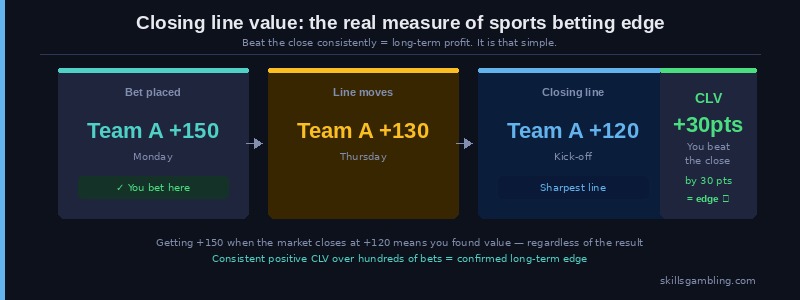
The closing line is the final odds offered on a market immediately before an event starts. Sharp bookmakers’ closing lines represent the most accurate available probability assessment for that outcome — they have been shaped by sophisticated modelling and refined by significant sharp money.
CLV measures the difference between the price you bet and the price the market closed at. If you bet a team at 2.20 and the market closed at 2.00, you achieved positive CLV — you got a better price than where the most informed money ultimately settled.
Why CLV Matters
If sharp bookmakers’ closing lines accurately reflect true probabilities (which is the working assumption), then consistently getting better prices than closing lines means consistently getting prices better than true probability — which is the definition of positive expected value.
CLV is significant because:
- It’s measurable on every bet, regardless of outcome
- It doesn’t require a large sample to assess (unlike win rate, which requires thousands of bets to be statistically meaningful)
- It directly predicts long-term profitability better than any other metric
Research across professional betting communities consistently finds that bettors who beat closing lines on 55–60%+ of their bets are long-run winners. Bettors who beat closing lines 50% or less of the time are at best breaking even.
How to Use CLV
After placing each bet, record:
- The odds you received
- The closing odds at a sharp bookmaker (Pinnacle is the standard reference)
- Whether you beat the close, matched it, or got a worse price
Over hundreds of bets, your CLV percentage is a more reliable indicator of your edge than your profit/loss figure, which variance distorts significantly over short samples.
How to Find Value in Sports Betting Markets
Finding genuine value requires either a better probability model than the bookmaker, or earlier access to information that the market hasn’t yet priced in. Both are achievable — neither is easy.
Building a Probability Model
The most rigorous approach is constructing your own probability model for outcomes and comparing it systematically against bookmaker lines.
What goes into a basic model:
- Historical results and margin of victory/defeat
- Strength of schedule and adjusted performance metrics
- Home/away splits and travel effects
- Injury and availability data
- Weather conditions (outdoor sports)
- Motivational factors (relegation battles, elimination games, resting players)
The goal is not to predict outcomes with certainty — that’s impossible. The goal is to produce probability estimates that are better calibrated than the bookmaker’s, often enough to generate positive EV over hundreds of bets.
Important: even well-constructed models are wrong frequently. A 60% probability estimate means the outcome should fail to occur 40% of the time. A string of losses is not evidence the model is broken; it may simply be variance. Calibrating the model requires large samples.
Market Timing
Bookmakers release lines in advance and adjust them as the game approaches. Early lines often contain more inefficiency because the bookmaker has less information and less sharp money has moved the price yet.
Betting early on markets you’ve identified as mispriced — before sharp money corrects the line — is one of the most reliable edge sources available. The flip side: early lines on games with significant upcoming information (injury news, lineup announcements) carry additional risk if that information breaks after you’ve placed your bet.
Finding Soft Lines
Different bookmakers price the same market differently. A team priced at 2.10 at one book might be priced at 2.25 at another — the same bet with a materially different expected value. Identifying and exploiting these discrepancies is called line shopping, addressed in the next section.
Niche Markets and Less-Covered Sports
Major football, NFL, NBA, and top-tier European leagues have enormous betting volume. Millions of pounds/dollars of sharp money and sophisticated models price these markets efficiently. Finding genuine edge in Champions League group stages or NFL week 1 games is extremely difficult.
Smaller leagues, lower divisions, and less-covered sports carry less sharp attention and more pricing inefficiency. A bettor with genuine domain knowledge in a niche — lower-league football, minor league baseball, emerging esports — can find better edge opportunities than in heavily analysed markets.
Line Shopping: The Free Edge Most Bettors Ignore
Line shopping — holding accounts at multiple bookmakers and consistently betting at the best available price — is the single most immediately accessible edge improvement available to any bettor.
It requires no model. No statistical analysis. No special knowledge. Just accounts at multiple books and the discipline to check prices before placing every bet.
The Mathematics of Line Shopping
Example: You want to bet on a Premier League home win. Prices at three bookmakers:
| Bookmaker | Odds | Implied Probability |
|---|---|---|
| Bookmaker A | 2.00 | 50.0% |
| Bookmaker B | 2.10 | 47.6% |
| Bookmaker C | 2.20 | 45.5% |
Betting at 2.20 instead of 2.00 on a bet you estimate has 50% true probability:
- At 2.00: EV = (0.50 × £1.00) − (0.50 × £1.00) = £0.00 (breakeven)
- At 2.20: EV = (0.50 × £1.20) − (0.50 × £1.00) = +£0.10 per £1 staked
The same bet goes from breakeven to +10% EV purely from price improvement. Over a betting career of thousands of bets, line shopping produces a structural improvement in returns that compounds dramatically.
Recommended Bookmaker Setup
At minimum, maintain accounts at:
- 1–2 sharp bookmakers (Pinnacle where available) — to track closing lines and benchmark your prices
- 3–5 soft bookmakers — where the best prices on specific markets often appear before being corrected
The soft books limit winning accounts, so maintain a wide selection and rotate your volume across them to extend account longevity.
Kelly Criterion: Optimal Stake Sizing
The Kelly Criterion is a mathematical formula for optimal bet sizing developed by John L. Kelly Jr. at Bell Laboratories in 1956. It determines what fraction of your bankroll to stake on a bet to maximise long-run bankroll growth without risking ruin.
Academic research published on arXiv has formalised Kelly betting as a Bayesian model evaluation framework — confirming that Kelly-sized bets reflect the true information content of your probability estimates over time.
The Formula
f = (bp − q) / b
Where:
- f = fraction of bankroll to stake
- b = decimal odds minus 1 (net profit per unit if you win)
- p = your estimated probability of winning
- q = your estimated probability of losing (1 − p)
Example: You estimate a team has a 55% probability of winning. Decimal odds: 2.10 (b = 1.10).
f = (1.10 × 0.55 − 0.45) / 1.10 = (0.605 − 0.45) / 1.10 = 0.155 / 1.10 = 14.1%
Full Kelly recommends staking 14.1% of bankroll. In practice, this is aggressive — small errors in your probability estimate can result in dramatic swings.
Fractional Kelly in Practice
Most professional bettors use quarter-Kelly or half-Kelly — staking 25–50% of the full Kelly recommendation. This reduces variance significantly while preserving most of the long-term growth advantage:
| Kelly Fraction | Stake (example above) | Growth rate preserved | Variance |
|---|---|---|---|
| Full Kelly | 14.1% | Maximum | Very high |
| Half Kelly | 7.1% | ~75% of max | Moderate |
| Quarter Kelly | 3.5% | ~50% of max | Low |
Half-Kelly is the most common professional choice. It provides a substantial buffer against the inevitable errors in probability estimation while still producing superior long-run growth to flat betting.
What Kelly Tells You That Nothing Else Does
The Kelly formula has a crucial built-in feature: when your estimated edge is zero or negative, it tells you to bet nothing. A bet you think is breakeven gets a Kelly stake of 0%. A bet you think is negative EV returns a negative number — meaning the formula would have you bet on the other side if possible.
This automatic filtering of negative-EV bets is why Kelly is so powerful as a discipline tool, not just a sizing formula.
Bankroll Management for Sports Bettors
Bankroll management in sports betting has one primary goal: surviving variance long enough for your edge to manifest in results. Even a genuine edge of 3–5% per bet produces enormous short-term swings. Without proper bankroll management, you go broke before your edge proves itself.
For a complete framework covering stake sizing across all gambling activities, our guide to bankroll management principles covers the full methodology.
Setting Your Bankroll
Your sports betting bankroll should be:
- A dedicated amount separate from personal finances
- An amount you can afford to lose entirely without financial harm
- Large enough to absorb significant variance without forcing you to reduce stakes
A minimum of 50–100 units at your standard stake is a sensible starting point. If you bet £10 per unit, your bankroll should be £500–£1,000 before starting.
Stake Sizing Rules
Flat staking: bet the same amount on every bet, regardless of confidence. Simple, eliminates emotion, easy to track. Standard flat stake: 1–3% of bankroll per bet.
Variable staking (Kelly-based): adjust stakes based on perceived edge. More sophisticated, requires accurate probability estimates, produces better long-run growth when estimates are well-calibrated.
Never bet more than 5% of bankroll on any single bet, regardless of how confident you feel. Confidence and accuracy are different things.
Handling Losing Streaks
Variance means losing streaks are inevitable — even for genuinely profitable bettors. A 20-bet losing run is statistically normal at typical win rates.
The instinctive response — increasing stakes to “get back quicker” — is one of the most reliable ways to destroy a betting bankroll. It turns a temporary variance swing into a structural disaster.
When losing: maintain stakes, continue placing only +EV bets, review your process (not your results), and trust the mathematics if your model is sound.
The Skill vs Luck Question in Sports Betting
Sports betting occupies a unique position on the skill versus luck spectrum in gambling. It is neither as skill-dominant as poker nor as luck-dependent as roulette. It sits somewhere in between — and exactly where depends on the bettor’s approach.
For a bettor placing emotional, narrative-driven bets on favourite teams with no odds comparison or probability assessment, sports betting is effectively a luck game with a systematic negative expected value.
For a bettor using statistical models, CLV tracking, line shopping, and disciplined bankroll management — sports betting becomes a skill activity where edge is measurable and, for a small minority, positive over large samples.
The honest reality of sports betting profitability:
- Professional bettors typically achieve win rates of 53–56% at standard odds — thin margins requiring thousands of bets to confirm statistically
- Edges of 2–5% above closing line are considered excellent performance
- Account restrictions from soft bookmakers are an active threat to profitability at scale
- Most bettors who think they have an edge do not — short sample sizes make losing bettors look like winners and winning bettors look like losers
Sports betting skill is real. It’s also narrower, harder to demonstrate, and more vulnerable to external constraints (account limiting) than skill in poker or other player-versus-player environments.
Bet Types Explained: Which Carry the Most Edge Opportunity
Not all bet types offer equal edge opportunities. Understanding the structure of each helps you direct analytical effort where it’s most likely to generate return.
Moneylines / Match Odds
The simplest bet: pick the winner. Markets are relatively efficient in major leagues but can be inefficient in niche sports and lower divisions. Good starting point for developing a model.
Point Spreads
Popular in American sports. The bookmaker handicaps the favourite to create a more balanced market. Key numbers (3 and 7 in NFL, reflecting typical scoring margins) create specific opportunities around line movements.
Totals (Over/Under)
Bet on the combined score exceeding or falling below a set line. Often less scrutinised than match odds or spread markets at smaller bookmakers — edge opportunities can be found by bettors with good game-total models.
Player Props
Bets on individual player statistical outcomes (goals, assists, passing yards, strikeouts). Less liquid markets that major sharp bookmakers don’t always price efficiently. Data-rich opportunities for bettors with strong player-level models. Carry higher margins at most operators.
Futures / Outright Markets
Bets on tournament or season outcomes — league winners, top scorer, relegation. Carry the highest margins of any standard market (often 15–25% overround across all selections) and tie up capital for months. Edge opportunities exist early in a season when bookmakers are pricing with limited information, but margins make futures difficult to beat long-term.
Parlays / Accumulators
Multiple bets combined into one, with multiplied payout if all selections win. The house edge compounds with each leg added — a two-leg parlay at −110/−110 carries a 9.1% house edge; a six-leg parlay carries over 30%. Parlays are the most profitable bet type for bookmakers precisely because the compounding margin makes them deeply unfavourable for bettors.
Single bets are almost always the correct vehicle for value betting. Parlays redistribute your stake into additional house edge.
Common Sports Betting Mistakes
These are the highest-frequency errors — the ones that turn sports knowledge into consistent losses.
Betting on Your Favourite Team
The single most reliable path to consistently poor expected value. Emotional attachment produces systematic biases — overestimating win probability, underweighting unfavourable circumstances, betting at prices you’d never accept on the other side. Professionals often avoid betting on teams they support entirely.
Evaluating Bets by Outcome
A bet that wins was not necessarily a good bet. A bet that loses was not necessarily a bad bet. Judging the quality of your decisions by their outcomes rather than their process is statistically illiterate and prevents genuine improvement. Track your CLV and your probability calibration — not your win/loss record.
Ignoring the Vig
Winning 50% of bets at −110 is a losing strategy. Many bettors don’t internalise this. Before assessing whether you have an edge, calculate the breakeven win rate for your average odds. Your actual win rate must exceed that breakeven rate for you to profit.
Chasing Losses
Increasing bet sizes after a losing run to recover faster is one of the most expensive and common mistakes in sports betting. It converts a normal variance swing into a structural bankroll problem. Preset loss limits and non-negotiable stake rules exist specifically to prevent this.
Betting Too Many Markets
Spreading across every sport, every league, and every bet type produces surface-level analysis and mediocre probability estimates everywhere. Profitable bettors typically specialise in 2–4 markets or bet types where they develop genuine model accuracy. Breadth is the enemy of edge.
Neglecting Line Shopping
Consistently taking the first price you see rather than the best available price is the equivalent of handing the bookmaker additional margin on every bet. Over a full year of betting, the difference between average-price and best-price bettor performance is substantial and cumulative.
Account Management: Staying in Action
The practical reality of sports betting at any serious level is that soft bookmakers — the ones where pricing inefficiencies are most exploitable — actively restrict accounts that win consistently.
This is not illegal. It’s a business decision. Sharp bettors are unprofitable customers for soft books, which are designed to serve recreational bettors.
How to Extend Account Longevity
Blend your betting profile. Soft books use pattern recognition to identify sharp bettors. Bettors who only bet on value, only on specific markets, only pre-game, and only at optimal prices look sharp. Adding occasional recreational-style bets, betting across a wider range of markets, and varying stake sizes makes profiles less easily identified.
Withdraw gradually. Large, immediate withdrawals after winning periods flag accounts. Consistent modest withdrawals are less conspicuous.
Use betting exchanges. Exchanges like Betfair (peer-to-peer betting) don’t limit winning accounts because they profit from commission on every bet regardless of outcome. Effective for value bettors who find their soft book accounts being restricted.
Maintain multiple accounts. Spreading your volume across many operators extends the lifespan of each individual account and broadens your line-shopping options simultaneously.
The Mental Game: Process Over Results
Sports betting produces outcomes that confirm or contradict your decisions within hours — a compressed feedback loop that creates powerful emotional responses. Managing those responses is a genuine skill that separates long-term profitable bettors from those who implode during variance.
Variance Is Not a Signal
A 15-bet losing streak at a 55% win rate has approximately a 0.3% probability of occurring. Over a career of thousands of bets, it will happen. When it does, it tells you almost nothing about whether your edge is real. The same applies in reverse: a 15-bet winning streak does not confirm your model is correct.
This is why CLV tracking matters more than results tracking, particularly in the short term. If you’re consistently beating closing lines, your process is sound — regardless of whether recent outcomes support that conclusion.
The Discipline of Doing Nothing
One of the most valuable skills in sports betting is the ability to not bet. When no markets present genuine edge, the correct action is to pass. Most bettors can’t do this — the urge to be in action overrides the mathematics. This is how negative-EV bets get placed even by bettors who understand value betting intellectually.
How professional gamblers maintain decision discipline across all forms of skill-based gambling is directly applicable here: evaluate decisions by process, accept outcomes as information, and never let results override your framework.
Record Keeping
Keep a detailed record of every bet:
- Date and market
- Bookmaker and odds taken
- Your estimated probability
- Closing odds at a sharp reference book
- Stake and result
This record is not just for tax purposes. It is the dataset that tells you whether your edge is real, where it comes from, and whether it’s improving or declining over time. Without it, you’re operating blind.
Responsible Gambling
Sports betting involves financial risk. No strategy guarantees profit. The 3–5% of long-term profitable bettors are the exception, not the norm. Past winning periods do not predict future results.
The framework in this guide is honest about the difficulty of sustained profitability. Most people who approach sports betting with the intention of profiting will not achieve it over meaningful sample sizes. This is not a failure of effort or intelligence — it reflects the genuine difficulty of outperforming well-capitalised, data-rich bookmaking operations consistently.
Warning Signs
- Betting with money you cannot afford to lose
- Increasing stakes to recover losses
- Betting driven by financial pressure rather than identified edge
- Inability to stop even when you want to
- Sports betting affecting relationships, work, or wellbeing
These are not signs that you need a better strategy. They are signs that gambling has become harmful and that support is needed.
Support Resources
- GamCare (UK): gamcare.org.uk / 0808 8020 133 (free, 24/7)
- BeGambleAware: begambleaware.org
- GAMSTOP (UK self-exclusion): gamstop.co.uk
- Gamblers Anonymous: gamblersanonymous.org.uk
- National Problem Gambling Helpline (US): 1-800-522-4700
FAQ
Can you actually make money sports betting long term?
Yes — approximately 3–5% of sports bettors profit long-term. Those who do share a common framework: they bet positive expected value, track closing line value rather than win rate, shop for the best available odds, manage stakes mathematically, and specialise in markets where their analysis produces genuine edge. It is genuinely difficult and requires treating sports betting as an analytical discipline rather than a prediction contest.
What is the breakeven win rate in sports betting?
At standard −110 odds (the most common American sportsbook price), you need to win 52.38% of bets to break even. At decimal odds of 1.90 (the equivalent in European pricing), the breakeven rate is 52.6%. Professional bettors typically achieve win rates of 53–56% — thin margins that require thousands of bets to demonstrate statistically.
What is closing line value and why does it matter?
Closing Line Value (CLV) measures whether the odds you bet were better or worse than where the market closed. Sharp bookmakers’ closing lines are considered the most accurate available probability assessments for outcomes. Consistently getting better prices than the close — positive CLV — is the most reliable indicator of long-term betting edge, because it shows you’re consistently finding mispriced odds before the market corrects them.
What is the Kelly Criterion in sports betting?
The Kelly Criterion is a mathematical formula (f = (bp − q) / b) that calculates the optimal fraction of your bankroll to stake on a bet given your estimated edge. It maximises long-run bankroll growth without risking ruin. Most professionals use quarter-Kelly or half-Kelly to reduce variance while preserving most of the growth advantage.
Why do bookmakers limit winning accounts?
Soft bookmakers — most retail and online operators — limit accounts that consistently win because sharp bettors are unprofitable customers. Their business model is built on recreational bettors who generate long-run losses. Bettors who consistently identify value force bookmakers to pay out at prices below their true cost, making them unprofitable to serve. This is why serious bettors maintain multiple accounts and use betting exchanges where possible.
Are parlays / accumulators worth betting?
Generally no, from a value perspective. The house edge compounds with each leg added — a four-team parlay at standard pricing carries roughly 18% combined house edge. They serve bookmakers’ profitability better than any other bet type. Occasional small-stake parlays as entertainment are reasonable; treating them as a primary betting vehicle destroys expected value.
How much bankroll do I need to start sports betting seriously?
There is no single answer, but a working principle: maintain at least 50–100 units at your standard stake. If you bet £20 per unit, have £1,000–£2,000 dedicated before starting. This provides enough cushion to survive normal variance without going broke during a losing run and being forced to change stakes before your edge has had enough sample size to show.
What is the overround in sports betting?
The overround (also called the vig, juice, or margin) is the built-in bookmaker profit margin in any market. It’s measured by summing the implied probabilities of all outcomes — the excess above 100% is the overround. A 5% overround means the bookmaker expects to retain 5p of every £1 wagered across all outcomes. Finding and backing bets where your edge exceeds the overround is the mathematical foundation of profitable sports betting.
Conclusion
Sports betting is the most analytically accessible form of skill-based gambling. Unlike poker, where you need table time to build skill, or blackjack card counting, which requires memorised systems and casino access — sports betting skill can be developed systematically through model building, data analysis, and structured record keeping.
The framework is clear:
- Find positive expected value — identify markets where your probability estimate exceeds the bookmaker’s implied probability
- Track closing line value — measure the quality of your prices, not your win rate
- Shop for best prices — never take the first price you see
- Size stakes with Kelly — bet in proportion to your edge, not your confidence
- Manage your bankroll — survive variance long enough for edge to show in results
- Specialise — build deep accuracy in 2–4 markets rather than surface knowledge across twenty
The difficulty is real. The 3–5% of bettors who profit long-term are not simply people who know more about sport. They are people who have built analytical frameworks, maintained discipline through variance, and approached betting as a probabilistic exercise rather than a prediction game.
That’s the work. There’s no shortcut around it. But for those willing to do it, sports betting offers what very few gambling activities do: a genuine, measurable, improvable skill edge.
Related Reading
- Value Betting in Sports: How to Find Edge Against the Market
- Expected Value in Gambling: The Complete Guide
- Bankroll Management: The Strategy That Protects Every Other Strategy
- How Professional Gamblers Think Differently
- Skill vs Luck: What Actually Determines Your Results
- Can Skill Overcome the House Edge?
- Online Poker Strategy: The Definitive Guide
SkillsGambling.com is an educational resource. Nothing published here constitutes financial advice or a guarantee of gambling outcomes. Gambling involves financial risk. Please gamble responsibly. 18+ only.