

Skill-Based Gambling: Where Decisions Change the Outcome
The House Doesn’t Always Win the Same Amount From Everyone
Most gambling content treats all players as equal. Put money in, spin the wheel, hope for the best. That’s accurate for some games. It’s completely wrong for others.
In certain games, the decisions you make directly determine how much you lose — or whether you can win consistently over time. The gap between an informed player and an uninformed one at the same blackjack table can be worth thousands of pounds per year. A skilled poker player and a recreational player sitting at the same table are not playing the same game. A sports bettor who finds genuine value in the odds and one who bets on gut feeling face entirely different long-run outcomes.
That gap is what this site is about.
SkillsGambling.com exists to explain — clearly and honestly — where skill genuinely matters in gambling, how much difference it makes, and what it actually takes to develop it. No miracle systems. No “beat the casino” hype. No guaranteed strategies. Just the kind of analysis that helps you make better decisions about where and how you play.
What Is Skill-Based Gambling?
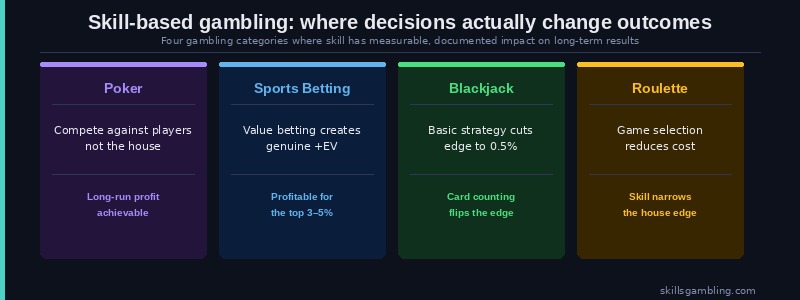
Skill-based gambling is any form of gambling where player decisions materially influence long-run outcomes.
The key phrase is long-run. In any single session, luck dominates. A novice can beat a professional at poker over one evening. A player making every wrong decision at blackjack can walk away up money. Short-run variance creates winners and losers regardless of skill level.
But over thousands of decisions — thousands of hands, bets, and sessions — a pattern emerges. Players who make better decisions produce better results. Not always. Not predictably in any given session. But measurably and consistently over time.
That’s the test of whether a game involves genuine skill: do better decisions produce better long-run outcomes?
In roulette, the honest answer is no. The ball doesn’t know who’s betting on it or why. No decision you make at a roulette table changes where it lands.
In poker, the honest answer is yes — emphatically. The same players appear at the top of major tournaments year after year. The same players sustain profitable cash game results over decades. That doesn’t happen by luck.
In blackjack, the answer is: it depends how you play. A player using mathematically correct basic strategy faces a house edge roughly six times smaller than one making intuitive decisions. Skill doesn’t eliminate the house edge — but it compresses it dramatically.
In sports betting, skill can theoretically flip the edge entirely — but the bar is high, and only a small fraction of bettors ever clear it.
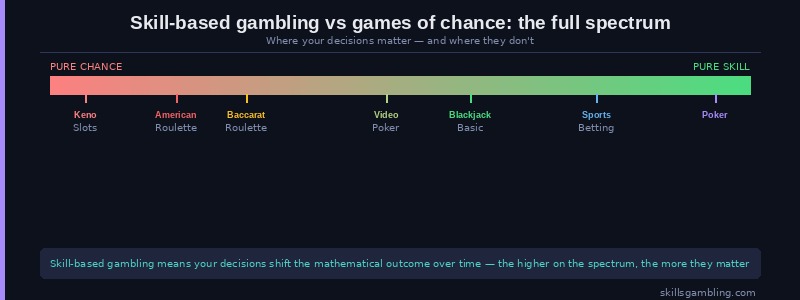
The spectrum between pure luck and genuine skill is wide. Knowing where each game sits on that spectrum is the most valuable piece of knowledge any gambler can have.
National Casino — Best for Roulette
VIP Tables · High Stake titles · Fast withdrawals
18+ · T&Cs apply · Gamble responsibly · begambleaware.org
Playamo — Best for Blackjack
Multiple variants · Low house edge · Live dealer
18+ · T&Cs apply · Gamble responsibly · begambleaware.org
Granawin Sports & Casino — Best for Sportsbetting
Cash games · Daily tournaments · Strong quotes
18+ · T&Cs apply · Gamble responsibly · begambleaware.org
The Skill Spectrum: Every Major Game Ranked
Not all games are equal. Here’s where skill genuinely lives across the most popular forms of gambling:
| Game | Skill Level | What Skill Actually Does |
|---|---|---|
| Poker | ⬛⬛⬛⬛⬛ Very High | Compete against players, not house. Better decisions = better long-run results |
| Sports Betting | ⬛⬛⬛⬛⬜ High | Finding mispriced odds can create genuine +EV. High bar to clear consistently |
| Horse Racing | ⬛⬛⬛⬛⬜ High | Handicapping skill creates edge in parimutuel markets |
| DFS | ⬛⬛⬛⬛⬜ High | Projection modelling and ownership strategy reward analytical skill |
| Blackjack | ⬛⬛⬛⬜⬜ Moderate | Basic strategy cuts house edge from ~3% to ~0.5%. Card counting can flip it |
| Skill-Based Casino Games | ⬛⬛⬛⬜⬜ Moderate | Player decisions influence outcomes within game mechanics |
| Video Poker | ⬛⬛⬛⬜⬜ Moderate | Optimal hold strategy approaches near-zero house edge |
| Roulette | ⬛⬜⬜⬜⬜ Very Low | Game/variant selection only. Ball outcomes are random |
| Baccarat | ⬛⬜⬜⬜⬜ Very Low | Bet selection only. Banker bet at 1.06% edge is the correct choice |
| Slots | ⬛⬜⬜⬜⬜ Very Low | RTP and volatility selection. Spin outcomes are RNG-determined |
The higher on the spectrum, the more your decisions matter — and the more time and study is required to develop meaningful edge.
Skill-Based Casino Games: The New Generation
In 2016, something changed in the casino industry.
For decades, the slot machine was the defining casino product: press a button, watch the reels, accept a random outcome. The player had no meaningful influence. Generations raised on video games — where skill determined outcomes — found this increasingly unappealing.
Game developers responded. A new category of skill-based casino games emerged: titles where player decisions, speed, knowledge, and ability directly influence results. Not just the betting amount. The outcome itself.
These games sit in a genuinely different category from traditional slots.
How Skill-Based Casino Games Work
In a traditional slot, the RNG determines the result before you see it. The spin animation is cosmetic.
In a skill-based casino game, the player’s decisions during gameplay — answering questions correctly, completing puzzles quickly, solving patterns accurately — affect how much they win. Two players betting the same amount can produce completely different results based on their skill level.
The better you are at the skill component, the better your results tend to be.
Popular formats include:
- Trivia and knowledge games — answer correctly to unlock prizes and multipliers (e.g. The Heist). General knowledge, speed, and accuracy determine payout levels.
- Puzzle-based games — solve word or visual puzzles under time pressure. Faster, more accurate players achieve higher returns (e.g. Buzzword Bingo).
- Arcade-hybrid games — reflex and decision-making games layered over a betting mechanic. Player performance directly influences outcomes.
- Strategy tournament games — competitive formats where players are ranked against each other, with prizes distributed based on performance.
The Honest Caveat
Skill-based casino games are a genuine development — player decisions genuinely matter in them. But transparency is important: all skill-based casino games still contain a luck element. The random components (which question appears, which symbols land, which path presents itself) mean that even highly skilled players have variance in their results.
The skill component narrows the range of outcomes and rewards the more prepared player. It doesn’t eliminate chance entirely. And all such games still operate within a regulated house margin.
If you’re new to skill-based casino games, start with knowledge-based formats — they reward preparation most directly and give you the clearest feedback on whether your skill is improving.
The Top 5 Casino Games Where Skill Changes Outcomes
Not every casino game is worth your time if you’re looking for genuine skill influence. Here are the five where preparation, strategy, and decision-making produce the clearest long-run difference.
1. Poker — The Pinnacle of Casino Skill
Skill influence: Maximum
Poker is categorically different from every other casino game. You’re not playing against a fixed mathematical house edge — you’re playing against other people. The house takes a small rake from each pot, but your results are determined by the gap between your decisions and your opponents’ decisions.
The evidence for poker as a skill game is overwhelming. The same players appear consistently at the top of major tournaments. Professional players sustain positive results over careers spanning decades. None of that is statistically possible in a pure luck game.
Where skill lives: hand selection, positional play, reading opponents, pot odds, bankroll management.
Where luck lives: the specific cards dealt on any given hand. Even the best players lose individual hands constantly.
Best for: players willing to invest serious study time. The skill ceiling is the highest of any casino game, and the potential for long-run profitability is real — but so is the learning curve.
2. Blackjack — The Most Accessible Skill Game
Skill influence: High (with correct approach)
Blackjack is unique among table games because the house edge isn’t fixed — it changes based on how you play. A player making random decisions faces an edge of roughly 3–4%. A player using mathematically correct basic strategy faces around 0.5%. A skilled card counter can theoretically create a small player edge.
That gap is meaningful. At £25 per hand over a four-hour session, the expected loss difference between random play and basic strategy is approximately £150. Over a year of regular play, the compounding difference runs into thousands.
Where skill lives: every decision — when to hit, stand, double, split, surrender. Game selection (3:2 vs 6:5, number of decks, rule variations).
Where luck lives: the cards dealt on any given hand. Even perfect strategy loses plenty of individual hands.
Best for: casino players who want a concrete, learnable skill that immediately reduces the cost of playing. Basic strategy takes a few hours to learn and is the best return on study time available at any casino table.
3. Skill-Based Casino Games — Strategy Meets Entertainment
Skill influence: Moderate to High (within game mechanics)
The new generation of skill-based casino titles — trivia games, arcade hybrids, puzzle formats — offer something traditional slots never did: your ability directly affects your results. Prepared players outperform unprepared players in measurable ways.
Where skill lives: game knowledge, speed, decision quality under pressure, pattern recognition.
Where luck lives: the random components baked into each game — which questions appear, which paths generate, which bonus triggers fire.
Best for: players who want genuine engagement and skill expression in a casino environment, without the deep learning curve of poker or blackjack.
4. Video Poker — Precision Pays
Skill influence: High (with optimal strategy)
Video poker is the slot machine’s intellectually honest cousin. The RNG deals the cards randomly — but you choose which to hold. In full-pay Jacks or Better with optimal hold strategy, the house edge approaches 0.5% — matching the best blackjack conditions.
The optimal strategy for each video poker variant fits on a single reference card. Like blackjack basic strategy, it’s learnable, freely available, and immediately reduces the cost of playing.
Where skill lives: the hold decision on every hand — which cards to keep and which to discard.
Where luck lives: which cards are dealt and which come in the draw.
Best for: players who enjoy a solitary, analytical experience and want near-zero house edge without competing against other players.
5. Sports Betting — Edge Through Analysis
Skill influence: High (but high bar)
Sports betting is theoretically the most powerful skill game available — because the “house edge” (the bookmaker’s vig) isn’t fixed by maths. It’s priced by analysts, and analysts make mistakes. A bettor who consistently identifies mispriced outcomes — bets where the odds underestimate the true probability — can sustain positive expected value over the long run.
In practice, this is genuinely difficult. Modern sportsbook pricing is sophisticated. Only approximately 3–5% of sports bettors sustain positive ROI long-term. And winning bettors face stake restrictions from most major operators.
Where skill lives: probability estimation, odds analysis, closing line value, bankroll management, market selection.
Where luck lives: every individual event outcome. Even accurate probability models are wrong regularly.
Best for: analytically minded players who follow specific sports deeply and are prepared to track every bet with rigorous data.
Skill vs Luck: The Honest Breakdown
Here’s a question worth asking clearly: can skill actually make a difference, or is it all luck in the end?
The answer depends entirely on which game you’re asking about — and which timeframe.
In the Short Run, Luck Dominates Everything
A novice poker player can beat a world-class professional in a single session. A blackjack player making every wrong decision can walk away profitable after 50 hands. A sports bettor with no analytical framework can run hot for a month.
Short-run results are overwhelmingly driven by variance — the natural randomness of outcomes. They tell you almost nothing reliable about whether skill is present or absent.
This is why so many gamblers overestimate their own skill. They win a few sessions, attribute it to good decision-making, and build false confidence. Then the variance corrects, and the underlying reality of their decisions becomes apparent.
In the Long Run, Skill Asserts Itself
Over thousands of poker hands, the same skilled players consistently outperform their competition. Over hundreds of sports bets, a bettor with genuine analytical edge beats the closing line consistently. Over thousands of blackjack hands, the player using basic strategy loses measurably less than the player guessing.
Skill is a long-run property. It is not a session-by-session guarantee.
This distinction is fundamental to understanding why serious gamblers think differently from recreational ones. They don’t ask “did I win tonight?” They ask “were my decisions correct?” Those are completely different questions — and only one of them is useful.
The Three Types of Gambling Outcomes
Understanding this distinction helps:
1. Pure luck games (roulette, baccarat, slots): Player decisions have minimal influence on outcomes. The house edge is fixed and immovable. Skill can influence game selection and bankroll management — but not the core result.
2. Skill-influenced games (blackjack, video poker, skill-based casino games): Player decisions materially change the house edge faced. Informed players face a meaningfully different financial reality than uninformed ones at the same table.
3. Competitive skill games (poker, sports betting, DFS): Players compete against other players or markets rather than a fixed house edge. Skilled players can sustain positive expectation over the long run — but the competition is real, and the learning curve is substantial.
“The honest message: skill matters — but in specific games, over sufficient volume, and at a cost in time and study that most recreational players won’t pay. Knowing which category you’re in before you sit down is itself a form of skill.”
The Mathematics Behind the Edge
You don’t need to be a mathematician to benefit from understanding gambling mathematics. But a few core concepts change how you see every bet you make.
House Edge: What You’re Really Paying
The house edge is the percentage of every bet the casino expects to retain over time. It’s not about any individual hand — it’s a long-run average. European roulette has a house edge of 2.7%. That means for every £100 wagered across millions of spins, the casino expects to keep £2.70.
Why this matters: the house edge varies enormously by game and by how you play. At a well-chosen blackjack table with basic strategy, the house edge can be as low as 0.5%. At a 6:5 blackjack table with no strategy, it can exceed 3.5%. At a keno machine, it can exceed 30%. You are choosing your cost per bet every time you decide which game to play and how.
Expected Value: The Professional’s Framework
Expected value (EV) is what a bet is worth on average over a large number of identical bets. A bet with positive expected value makes money over time. A bet with negative expected value loses money over time.
Most casino bets are negative EV. The house edge builds in a guaranteed negative expectation for the player across enough volume.
In skill games, positive EV is achievable — but it requires decisions that are demonstrably better than the benchmark (the market, the house, or your opponents). The relationship between skill and the house edge is more nuanced than most gambling content admits.
Variance: Why Short-Run Results Lie
Variance is the natural randomness of outcomes that creates short-run results completely disconnected from long-run expectations. It’s why bad players win sessions and good players lose months.
Understanding variance is what separates gamblers who improve from those who perpetually cycle between false confidence and confusion. If you know variance is responsible for short-run noise, you stop changing strategy based on recent results — and start evaluating decisions on whether they’re mathematically correct.
What You’ll Find on This Site
SkillsGambling.com covers the full spectrum of skill-based gambling — from the new generation of skill casino games through to the analytical disciplines of professional poker and sports betting.
Core Guides
- Skill vs Luck in Gambling — the complete breakdown of which games involve real skill and where luck remains dominant. The best starting point on the site.
- What Is the House Edge? — how casino margins are built, why they vary so widely, and how to use that knowledge to make better game choices.
- Expected Value Explained — the single most important mathematical concept in gambling, explained from the ground up with real examples.
- Can Skill Beat the House Edge? — an honest, game-by-game analysis of where skill genuinely compresses or flips the mathematical disadvantage.
- Value Betting in Sports — how professional sports bettors find and measure genuine edge against bookmaker pricing.
Strategy Guides
- Blackjack Basic Strategy: The Complete Chart (coming soon)
- Bankroll Management: Protecting Your Money (coming soon)
- Poker Pot Odds and Expected Value (coming soon)
- How Professional Gamblers Think Differently (coming soon)
Responsible Gambling
SkillsGambling.com believes in informed gambling. That means being honest about risk as much as it means being honest about skill.
No gambling strategy guarantees profit. Even in skill-dominant games like poker and sports betting, losses are inevitable — variance is real, and the learning curve is long. The majority of gamblers lose money over time. That is the mathematical reality of most gambling environments, and no amount of skill changes it for everyone.
Gambling should be approached as entertainment with a defined cost — not as an income source or financial strategy. The skill element in certain games can reduce that cost for informed players, and occasionally eliminate it for exceptional ones. But it does not eliminate risk, and it does not guarantee positive outcomes.
If gambling is causing financial stress, affecting relationships, or feeling compulsory rather than enjoyable, please use the tools available:
- Deposit limits — cap how much you can load into any gambling account
- Session time limits — set automatic cut-offs on your playing time
- Time-outs — temporary breaks from gambling, available immediately
- Self-exclusion — remove yourself from gambling platforms for extended periods
These tools are free, available through all regulated gambling providers, and effective. Using them is a sign of good judgement — not weakness.
For immediate support, organisations including GamCare (UK), the National Problem Gambling Helpline (US), and Gambling Help Online (Australia) provide free, confidential assistance.
FAQ
What is skill-based gambling?
Skill-based gambling refers to gambling activities where player decisions, knowledge, or ability materially influence outcomes over the long run. In pure luck games like roulette and slots, no player decision changes the outcome. In skill games like poker and blackjack, better decisions produce measurably better results over time. The degree of skill influence varies widely by game — from minimal in baccarat to very high in poker.
Which casino games involve the most skill?
Poker involves the most skill of any casino game — players compete against each other, not a fixed house edge, and consistent decision quality determines long-run results. Blackjack is the most skill-accessible casino table game — basic strategy dramatically reduces the house edge and is learnable in a few hours. Sports betting, DFS, and horse racing handicapping all involve high skill components but require significant analytical investment. Skill-based casino games (trivia, arcade, puzzle formats) offer genuine skill influence within a casino environment.
Can skill actually beat the house edge?
In most casino games, no — the house edge is mathematically fixed and skill cannot overcome it regardless of decisions. In blackjack, basic strategy reduces the edge to approximately 0.5% and card counting can create a theoretical player advantage. In poker, skilled players can beat the rake because they compete against opponents rather than the house. In sports betting, genuine analytical edge can overcome the bookmaker’s vig — but only for a small minority of bettors. See our full analysis in the dedicated skill vs house edge guide.
What are skill-based casino games?
Skill-based casino games are a category of casino titles where the player’s in-game performance — answering questions, completing puzzles, demonstrating speed or knowledge — directly influences the payout. Unlike traditional slots where the RNG determines results before the player acts, skill-based games reward better-performing players with better outcomes. All such games still contain a random element and operate within a regulated house margin, but the skill component meaningfully differentiates player results.
Is poker a game of skill or luck?
Poker is primarily a game of skill over a large enough sample size. Individual hands are heavily luck-dependent — any two cards can win any given hand. But over thousands of hands, better decision-making consistently produces better results. The evidence is compelling: the same skilled players appear at the top of major tournaments year after year, and professional players sustain profitable careers over decades. Neither outcome is possible in a purely luck-based game.
How do I start learning skill-based gambling?
The most accessible entry point is blackjack basic strategy — it’s learnable in a few hours, freely available online and in reference card format, and immediately reduces the house edge from ~3% to ~0.5%. For poker, starting with Texas Hold’em fundamentals (hand rankings, position, pot odds) and practising at low stakes is the standard professional pathway. For sports betting, learning to calculate implied probability from odds and tracking your bets against closing line value is the foundation of a disciplined approach. All three disciplines reward patience, study, and honest self-assessment over time.
What is the house edge and why does it matter?
The house edge is the percentage of every bet the casino expects to keep over time. A 2.7% house edge means the casino retains £2.70 of every £100 wagered across a large enough sample. It matters because it varies enormously — from over 15% on some slot machines to as low as 0.5% on well-played blackjack. Choosing games with lower house edges, and applying skill where skill reduces the edge further, is the single most impactful set of decisions any gambler makes.
Conclusion
Skill in gambling is real — but it’s not magic, it’s not a guarantee, and it doesn’t apply equally to every game.
What it is: a measurable, long-run influence on outcomes in specific games, where better decisions produce better results over sufficient volume. It takes study, discipline, and honest self-assessment to develop. It doesn’t eliminate variance or make individual sessions predictable. And it requires choosing the right game — because in roulette and baccarat, the most skillful decision available is simply to understand the odds and manage your money accordingly.
What SkillsGambling.com offers is the honest version of that picture. Not “skill beats the casino.” Not “luck is all that matters.” The real spectrum — game by game, mechanic by mechanic — with the mathematics explained clearly and the practical implications laid out for every type of player.
Start with the game you play most. Understand where skill lives in it. Then decide how much of that skill is worth developing.
All content on SkillsGambling.com is for informational and educational purposes only. No gambling strategy guarantees profit. All gambling involves financial risk. Past performance does not predict future results. You must be 18 or over to gamble. Please gamble responsibly.