
Quick Answer
Bankroll management is the discipline of sizing your bets relative to your total gambling funds so that normal losing runs don’t eliminate you before your skill has time to show. It’s not a system for winning more. It’s the framework that keeps you in the game long enough for the maths to work in your favour — if you have genuine edge. Without it, even a skilled player can go broke through variance alone. With it, you give your decisions the sample size they need to matter.
Introduction
Most gambling content focuses on the decisions you make at the table or on the screen. Which hand to play. When to fold. Which odds represent value. How to read a count.
All of that matters. But there’s a less discussed discipline that sits underneath every one of those decisions — one that determines whether your skill ever gets the chance to produce results. That discipline is bankroll management.
Here’s the problem it solves. Even a player with genuine edge loses regularly. A professional poker player making consistently correct decisions still experiences stretches of 50, 100, or 200 losing buy-ins through normal variance. A sports bettor with documented positive closing line value can lose money for three consecutive months. A blackjack card counter with a real edge can have sessions, weeks, even months that look identical to a losing player’s results.
Variance is not a bug in gambling. It’s a permanent feature. The question is whether your bankroll is large enough relative to your stakes to survive the inevitable downswings and remain in the game long enough for your edge to assert itself.
That’s what bankroll management determines. Get it right and you protect your edge from variance. Get it wrong and you can go broke playing correctly — which is one of the more frustrating ways to lose money.
“Bankroll management doesn’t create an edge. It protects the edge you already have from being destroyed by variance before it can show up in your results.”
What Is a Bankroll?
Your bankroll is the total amount of money you’ve set aside exclusively for gambling — separate from living expenses, savings, and every other financial obligation.
This separation is not optional. It’s the foundation of every other bankroll management principle.
Why it matters: when gambling funds are mixed with everyday money, two problems emerge. First, you lose track of your actual results — it becomes impossible to evaluate whether your decisions are producing positive or negative outcomes over time. Second, losing sessions create psychological pressure that bleeds into decisions. A player who knows rent money is at risk plays differently — worse — than one gambling with funds set aside specifically for that purpose.
A properly defined bankroll has three characteristics:
- It’s money you can afford to lose entirely without affecting your quality of life
- It’s dedicated exclusively to gambling — nothing else uses it
- It has a defined replenishment policy — you know in advance under what conditions and how you’d add to it
None of this is about gambling more. It’s about gambling more clearly — with accurate information about your actual financial situation at all times.
Why Bankroll Management Is a Skill
Bankroll management is discussed as if it’s simply sensible money handling. It’s more than that. In skill-based gambling, it’s a core technical competency — one that sits alongside decision quality as a determinant of long-run outcomes.
Here’s why:
The Risk of Ruin Problem
Every gambler faces a concept called risk of ruin — the probability of losing your entire bankroll before variance resolves in your favour.
Risk of ruin is not zero even for skilled players. It depends on three variables:
- Your edge — how much positive expected value your decisions generate per bet
- Your bet size relative to bankroll — what percentage of total funds you stake per decision
- The variance of the game — how widely individual results swing around the long-run average
If your edge is real but your bet sizing is too aggressive relative to your bankroll, variance can eliminate you before the edge becomes visible. This is not a theoretical concern — it happens to skilled players regularly, particularly those who move up in stakes too quickly or who fail to account for the variance in their specific game.
The formula is uncomfortable but honest: a player with 5% edge at blackjack, staking 10% of their bankroll per hand, faces a meaningful risk of ruin even if their decisions are correct. Reduce the stake size to 1% of bankroll per hand and the risk of ruin collapses. The edge doesn’t change. The survival probability does.
Variance by Game Type
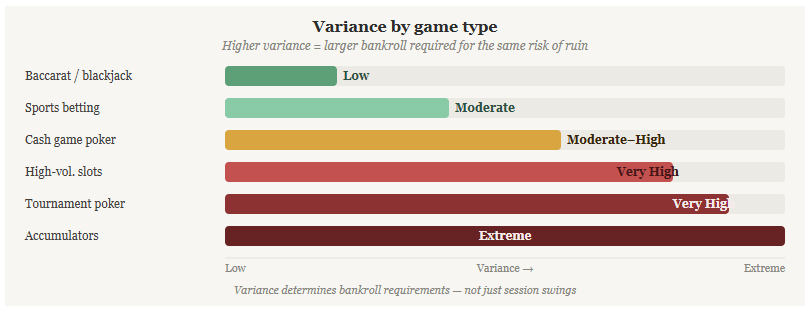
Different gambling formats carry dramatically different variance. Bankroll requirements aren’t universal — they scale with the swings inherent in your specific game.
| Game | Variance Level | Why |
|---|---|---|
| Baccarat / Blackjack (even money bets) | Low | Binary outcomes, small pay differentials |
| Sports betting (match odds) | Moderate | Results are binary but odds vary widely |
| Cash game poker (6-max) | Moderate-High | Many possible outcomes per session |
| Tournament poker | Very High | Most entries return zero; occasional large scores |
| Slots (high volatility) | Very High | Long dry spells interrupted by irregular large wins |
| Sports betting (accumulators) | Extreme | Near-certain loss, occasional massive payouts |
Higher variance means larger bankroll requirements for the same risk of ruin. A tournament poker player needs a much larger bankroll relative to their buy-in than a cash game player. This isn’t a preference — it’s mathematics.
Core Bankroll Management Principles
Principle 1: Define Your Unit Size
A unit is your standard bet — the base amount you stake on a single decision when you have no particular reason to deviate.
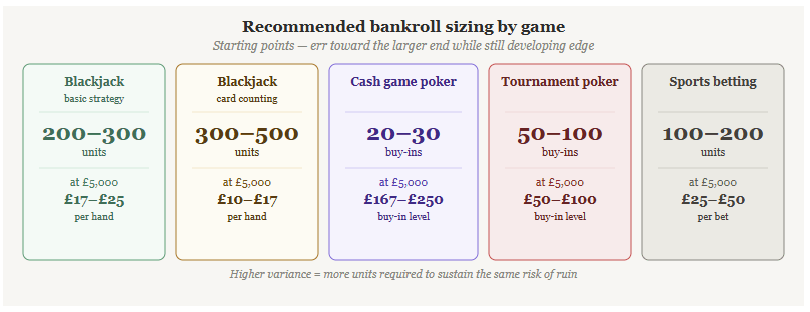
The appropriate unit size depends on your bankroll, your game, and the variance level you’re operating in. General guidelines:
| Game | Recommended Units in Bankroll | Meaning at €/£/$,000 bankroll |
|---|---|---|
| Blackjack (basic strategy) | 200–300 units | €/£/$17–€/£/$25 per hand |
| Blackjack (card counting) | 300–500 units | €/£/$10–€/£/$17 per hand |
| Cash game poker | 20–30 buy-ins | €/£/$167–€/£/$250 per session |
| Tournament poker | 50–100 buy-ins | €/£/$50–€/£/$100 buy-in level |
| Sports betting | 100–200 units | €/£/$25–€/£/$50 per bet |
These are starting points, not universal rules. Players with higher variance profiles, or who are still developing their edge, should err toward the larger end of these ranges.
The discipline is in sticking to the unit size you’ve defined — not in choosing the right number and then abandoning it when you’re running well and want to bet more, or when you’re running badly and want to recover faster.
Principle 2: Never Chase Losses With Bigger Bets
The single most costly bankroll management error in gambling is increasing bet size to recover from losses.
This happens for understandable psychological reasons. A session goes badly. The unit size that felt comfortable on the way in starts to feel insufficient to get back to even. The temptation is to increase stakes and shorten the path to recovery.
The mathematics of this decision are unfavourable in every direction:
- If you have no edge, larger bets simply accelerate losses at the same rate
- If you have positive edge, larger bets increase variance and worsen risk of ruin — the opposite of what a skilled player needs
- If you’re on tilt — emotionally compromised by losing — your decision quality is likely already worse, making higher stakes doubly dangerous
“Losing runs feel like aberrations that need correcting. They’re not. They’re the normal mathematical texture of any gambling activity with variance. The correct response is smaller bets and clearer thinking — not larger bets and faster recovery attempts.”
The professional discipline is stark: your bet size is determined by your bankroll and your edge, not by your recent results. A skilled player who has lost 30 buy-ins should be playing smaller, not larger, to manage risk of ruin during a potential downswing.
Principle 3: Move Down in Stakes Before You’re Forced To
Stop-loss rules are predefined points at which you reduce your stake size — not because you’ve become a worse player, but because your bankroll can no longer sustain the same risk of ruin at your current stakes.
A sensible stop-loss approach for cash game poker: if your bankroll drops below 20 buy-ins for your current stake level, move down to a level where you have 20+ buy-ins. This is not a judgment on your ability. It’s a mathematical response to the reality that your current bankroll can no longer absorb the variance at your current stakes without an elevated risk of ruin.
Many players resist moving down because it feels like an admission of failure. This is backwards. Moving down is the correct decision. Staying at stakes your bankroll can’t sustain is the error.
The corollary is equally important: move up in stakes only when your bankroll comfortably supports the new level. Running well for a month doesn’t justify moving up. Having the bankroll to support the move comfortably at the required number of units is what justifies it.
Principle 4: Keep Accurate Records
You cannot manage a bankroll you don’t measure. This sounds obvious. In practice, most gamblers have only a vague sense of their actual results over any meaningful time period.
Accurate record-keeping requires logging, for every session:
- Date, game, and stakes
- Starting bankroll and ending bankroll
- Session result in units and in currency
- For sports bettors: the odds taken and closing odds (to track closing line value)
- Any significant decisions or deviations from standard play worth noting
The purpose isn’t bureaucracy. It’s information. Without it, you can’t distinguish genuine positive edge from a lucky stretch of variance. You can’t identify whether a downswing is within normal parameters or evidence of a deeper problem. You can’t make rational decisions about stake sizes, game selection, or whether to continue at a given level.
Records are the only honest feedback mechanism available in gambling. Everything else — feelings, impressions, memories — is distorted by recency bias and the emotional texture of wins and losses.
Principle 5: Separate Gambling Funds From Living Expenses
This was stated at the outset and bears repeating as a principle in its own right, because it’s the most commonly violated bankroll rule — and the one with the most damaging consequences.
Gambling with money that has another purpose destroys the clarity bankroll management is designed to create. It introduces psychological pressure that compromises decision-making. It blurs the picture of actual results. And it creates the conditions under which gambling stops being an analytical activity and starts being a financial problem.
The rule is absolute: your bankroll is money you can afford to lose entirely. If losing the entire amount would cause hardship, it’s not a bankroll — it’s a risk you can’t afford to take.
Bankroll Management by Game
The principles above apply across all forms of gambling. The specific application varies meaningfully by game.
Poker Bankroll Management
Poker carries the most demanding bankroll requirements of any gambling activity — because variance in poker, particularly tournament poker, is extremely high.
Cash games: The standard professional guideline is 20–30 buy-ins for your target stake level. At €/£/$1/€/£/$2 (typical buy-in €/£/$200), that means a dedicated poker bankroll of €/£/$4,000–€/£/$6,000 minimum. More conservative players maintain 40–50 buy-ins.
Why so many? Consider: a skilled cash game player might have an edge of 5–10 big blinds per 100 hands. Over any individual session of 500 hands, their edge produces maybe €/£/$25–€/£/$50 in expectation. But the standard deviation of a 500-hand session at €/£/$1/€/£/$2 might be €/£/$300–€/£/$400. A string of sessions at the unfavourable end of that distribution is entirely possible — and requires a bankroll large enough to survive it.
Tournament poker: Requirements are substantially higher. 50–100 buy-ins is the standard professional recommendation, with some bankroll coaches suggesting 100–200 for high-variance tournament formats.
This is because tournament results are extremely binary. The vast majority of entries return nothing. A profitable player might cash in 15–20% of tournaments and make their money from a small number of deep runs. A run of 50 consecutive cashes below the money — all within normal statistical variance — depletes a bankroll quickly at aggressive stake levels.
The role of expected value in poker decisions and bankroll size are directly linked: your bankroll needs to be large enough that no single decision, however correct, can eliminate you from the game.
Blackjack Bankroll Management
Blackjack bankroll requirements depend heavily on how you’re playing.
Basic strategy player: Variance in blackjack is relatively low compared to poker. A bankroll of 200–300 units (where 1 unit = your standard bet) gives comfortable protection against normal downswings. At €/£/$10 per hand, that’s a dedicated blackjack bankroll of €/£/$2,000–€/£/$3,000.
Practical reality check: even at 0.5% house edge with basic strategy, the player is on the negative side of the maths over sufficient volume. The bankroll is protecting you from short-run ruin in a game where you’re the mathematical underdog — which is a legitimate reason to play, but honest sizing requires acknowledging that reality.
Card counters: Requirements are substantially larger — 300–500 units or more — because card counting requires spreading bets significantly (betting much more when the count is favourable, much less when it’s not). This bet spread increases both the edge and the variance simultaneously. A counter with a 1% edge and a 1-to-12 bet spread faces considerably more session-to-session variance than a flat-betting basic strategy player.
The mathematics of card counting bankroll requirements are well-documented in academic gambling literature. The University of Chicago’s research on gambling probability provides a rigorous foundation for understanding how edge, variance, and bankroll interact in this context.
Sports Betting Bankroll Management
Sports betting bankroll management has an additional layer of complexity: the Kelly Criterion.
Flat staking: the simplest approach. Stake the same fixed unit — typically 1–2% of total bankroll — on every bet regardless of perceived edge. This is mathematically suboptimal but psychologically sustainable and protects against the overconfidence that plagues more complex approaches.
At €/£/$5,000 bankroll with 1% flat staking: €/£/$50 per bet, 100 bets to lose the entire bankroll at maximum loss scenario. In practice, with any positive edge, you’ll win enough bets to sustain the bankroll for a very long time.
Kelly Criterion: the mathematically optimal staking approach, sizing each bet proportionally to the edge you estimate it carries.
Kelly fraction = (bp − q) ÷ b
Where:
- b = decimal odds − 1 (profit per unit staked)
- p = your estimated probability of winning
- q = 1 − p (your estimated probability of losing)
A bet at 3.00 where you estimate 45% probability: Kelly = (2 × 0.45 − 0.55) ÷ 2 = (0.90 − 0.55) ÷ 2 = 0.175 = 17.5% of bankroll
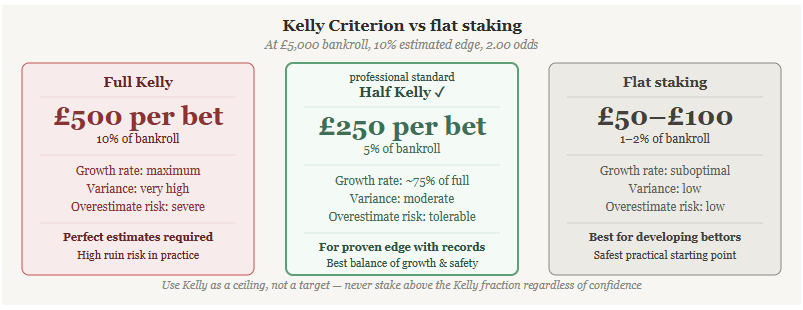
Full Kelly is theoretically optimal but practically dangerous. Probability estimates in sports betting are always uncertain — if your 45% estimate is actually 38%, full Kelly dramatically overstakes and accelerates ruin.
The professional standard is fractional Kelly — typically 25–50% of the full Kelly recommendation. Research from the Wharton School found that full Kelly led to significantly worse outcomes than fractional Kelly in realistic betting simulations, with partial Kelly at 0.50 coefficient offering the best balance of growth and variance control.
At half-Kelly in the example above: 8.75% of bankroll per bet. Still aggressive for most recreational bettors — which is why flat staking at 1–2% is the more practical starting point for anyone still developing their probability estimation skills.
The practical rule: never stake more than 5% of your sports betting bankroll on any single bet, regardless of how confident you feel. Confidence is not the same as edge. And edge estimates in sports betting are almost always less precise than they feel.
Casino Games Bankroll Management
For fixed-odds casino games — blackjack basic strategy, baccarat, roulette — bankroll management serves a different purpose than in skill games.
In these games, the house edge is fixed and negative for the player. Bankroll management cannot change the long-run mathematical outcome. What it can do is:
- Control session risk — ensuring one bad session doesn’t eliminate your entire gambling budget
- Extend entertainment value — more sessions for the same total expected cost
- Prevent catastrophic emotional decisions — knowing in advance when you’ll stop removes in-session decision-making about when to quit
A practical casino session framework:
Set a session budget before you sit down — typically 5–10% of your total gambling bankroll. When it’s gone, the session ends. No reloading from other funds. No “just one more twenty.”
Set a win target too — not because winning targets are mathematically meaningful, but because they prevent the common pattern of giving back winnings by continuing to play after a fortunate session. A player who books a 50-unit win and walks away has captured a good variance outcome. A player who continues until they lose it back has simply returned to the long-run expected result.
The Kelly Criterion: A Deeper Look
The Kelly Criterion deserves its own treatment because it’s both the most theoretically sound staking system available and the most misapplied.
Developed by physicist John L. Kelly Jr. at Bell Labs in 1956, the Kelly Criterion was originally created for information theory but its application to gambling and investing was immediately recognised. It answers a specific question: given a known edge on a bet, what fraction of your bankroll should you stake to maximise long-run growth?
The mathematics are elegant. Full Kelly, when your probability estimates are accurate:
- Maximises the long-run growth rate of your bankroll
- Guarantees you never go broke (theoretically — fractions of a bankroll can never reach zero)
- Automatically scales bet size with both edge size and bankroll size
The practical problems:
Your probability estimates are never perfectly accurate. Even sophisticated sports bettors and poker players work with estimates that carry meaningful uncertainty. If you overestimate your edge and stake at full Kelly, you dramatically overstake and risk of ruin increases sharply.
Full Kelly produces extreme variance. Even with accurate estimates, full Kelly creates swings of 30–50% of bankroll that are psychologically difficult to manage. Most professionals find fractional Kelly (25–50%) produces nearly equivalent long-run growth with dramatically less variance.
Kelly is undefined for negative-edge bets. The formula produces a negative staking fraction when EV is negative — which is mathematically correct (don’t bet), but requires honest EV assessment before applying it.
The practical takeaway: use Kelly as a ceiling, not a target. If Kelly suggests 12% of bankroll and you’re staking 3%, you’re fine. If Kelly suggests 3% and you’re staking 10%, you have a problem regardless of how good your edge looks.
Staking Systems That Don’t Work
A bankroll management guide would be incomplete without addressing the systems that are consistently marketed as solutions and consistently fail.
The Martingale System
Double your bet after every loss. When you win, you recover all previous losses plus a small profit.
Why it fails: Table limits and finite bankrolls mean the required doubling eventually exceeds what’s available. A run of 8 consecutive losses — well within normal probability in any even-money game — requires a bet 256 times the original stake on the ninth bet. Most table limits prevent this. Most bankrolls can’t sustain it.
More fundamentally: the Martingale doesn’t change expected value. Each individual bet carries the same negative EV. The system doesn’t alter the underlying mathematics — it redistributes wins and losses into a pattern of frequent small wins and occasional catastrophic losses, while the house edge extracts the same percentage regardless.
The Fibonacci System
Stake according to the Fibonacci sequence (1, 1, 2, 3, 5, 8, 13…), moving forward after losses and backward after wins.
Same fundamental problem as Martingale. The stakes required after extended losing runs quickly become unsustainable, and the system does nothing to change the underlying expected value of any individual bet.
The D’Alembert System
Increase stakes by one unit after a loss, decrease by one unit after a win.
Slower progression than Martingale — which means it takes longer to reach dangerous stake levels. But the same logic applies: it doesn’t change EV, and extended losing runs still create compounding stake requirements that outpace sensible bankroll management.
“The appeal of staking systems is that they feel like they’re doing something structural — like they’ve found an angle the maths missed. They haven’t. The expected value of any series of negative-EV bets, in any sequence, is still negative. Systems redistribute the texture of that negative expectation; they don’t eliminate it.”
The correct staking system: flat betting at a unit size your bankroll can sustain, or fractional Kelly if you have documented positive edge and accurate probability estimates. Everything else is noise.
Bankroll Management Across a Gambling Career
Bankroll management isn’t just session-to-session discipline. For players who take gambling seriously over extended periods, it’s a framework for managing their entire relationship with the activity.
Moving Up in Stakes
The temptation to move up in stakes after a good run is one of the most common mistakes in gambling. A month of running well doesn’t establish that you have the edge required to beat higher stakes — it establishes that variance was favourable during that period.
Move up when your bankroll comfortably supports the new level at the required number of units. Not when you’re running hot. Not when you feel ready. When the maths support it.
Specifically: if you’re a poker player and have built your bankroll to 30 buy-ins for the next stake level up, that’s the mathematical signal to move. Not before.
Moving Down in Stakes
Moving down is the correct response when a downswing has reduced your bankroll below the threshold required to sustain your current stakes with acceptable risk of ruin.
A player with 15 buy-ins for their current stake should be playing a stake level where they have 20+ buy-ins. Moving down preserves the bankroll and the option to move back up when results recover.
The psychological difficulty of moving down is real. It feels like regression. In mathematical terms, it’s the opposite — it’s protecting the bankroll that represents your ability to keep playing.
Recognising When Variance Is Not the Problem
Bankroll management assumes that downswings are variance. Sometimes they’re not.
If your results are negative over a very large sample — thousands of poker hands, hundreds of sports bets — and you’ve been tracking accurately, the downswing may be telling you something real about the quality of your decisions. Variance at that scale is unlikely to account for sustained negative results.
Honest self-assessment at this point matters more than any staking rule. The correct response to a skill problem is to address the skill — study, review, coaching — not to reduce stakes and wait for variance to rescue results that are genuinely below expectation.
Pros and Cons: Strict Bankroll Management
| Benefit | Challenge |
|---|---|
| Protects against ruin during normal downswings | Requires accepting smaller stakes than feel right in the short term |
| Creates accurate performance data over time | Demands consistent record-keeping discipline |
| Removes emotional decision-making about bet sizing | Moving down in stakes feels like failure, even when it’s correct |
| Gives genuine edge time to assert itself | Results still look like noise over short samples even with correct sizing |
| Enables rational stake progression over time | Progress is slower than many players want |
| Separates gambling funds from personal finances | Requires genuine financial discipline outside of gambling |
Expert Insight: What Professionals Do Differently
The most striking difference between professional gamblers and recreational ones on bankroll management isn’t the specific numbers they use. It’s the consistency with which they apply them.
Professionals don’t make exceptions. The unit size is the unit size. The stop-loss trigger is the stop-loss trigger. The move-up threshold is the move-up threshold. These rules exist precisely for the moments when emotions argue for deviation — and professionals apply them mechanically, not because they feel right in the moment, but because they’ve decided in advance that the rules are correct and emotions are not a reliable guide.
Professionals think in expected value, not in results. A losing month doesn’t change the unit size if the bankroll still supports it and the decisions are still correct. A winning month doesn’t justify moving up until the bankroll mathematically supports the next level. The unit size is determined by maths, not by mood.
Professionals have separate bankrolls for separate activities. A player who plays both cash game poker and sports betting has two separate bankrolls, sized independently for each activity’s variance. Mixing them obscures results and complicates rational management of both.
Professionals track everything. Not because they enjoy spreadsheets, but because the alternative — making decisions based on impression and memory — is less reliable than data. Memory distorts gambling results systematically: wins are remembered more vividly than losses, good decisions that didn’t work are forgotten, bad decisions that happened to win are remembered as good ones.
Responsible Gambling
Bankroll management is an analytical framework, not a protective system against gambling harm. It addresses mathematical risk — not the psychological risks that can develop around gambling for some people.
No bankroll management approach makes gambling financially safe over the long run in negative-EV games. The house edge is real and persistent. Managing your bankroll correctly reduces the rate of loss and prevents catastrophic sessions — it doesn’t change the direction of long-run outcomes in fixed-odds games.
More importantly: bankroll management assumes that gambling is a rational, controlled activity. For some people, and in some periods, it isn’t. Stake limits, session limits, and defined bankrolls are useful disciplines — but they’re not barriers that prevent harmful patterns from developing when someone is in a difficult relationship with gambling.
If gambling is generating financial stress, influencing decisions outside of the activity itself, or feeling compulsory rather than recreational, the right tools are not staking rules. They are deposit limits, session time limits, time-outs, and self-exclusion — available free through all regulated gambling providers, effective immediately, and worth using without hesitation.
FAQ
What is bankroll management in gambling?
Bankroll management is the practice of sizing your bets relative to your total dedicated gambling funds so that normal losing runs — which happen to all players, including skilled ones — don’t eliminate you before your edge has the chance to produce results. It’s not a system for winning more money. It’s the framework that keeps you in the game long enough for skill to matter.
How big should my gambling bankroll be?
It depends on your game and your stake level. For cash game poker, professional guidelines suggest 20–30 buy-ins minimum. For tournament poker, 50–100 buy-ins. For blackjack with basic strategy, 200–300 units. For sports betting, 100–200 units at your standard stake. These figures are sized to give your edge (if you have one) time to assert itself through normal variance, while keeping risk of ruin at an acceptable level.
What is the Kelly Criterion and should I use it?
The Kelly Criterion is a mathematical formula that tells you the fraction of your bankroll to stake on a bet given your estimated edge. It maximises long-run bankroll growth when your probability estimates are accurate. In practice, most professionals use fractional Kelly (25–50% of the full Kelly recommendation) because full Kelly produces extreme variance and requires perfectly accurate probability estimates to work as intended. For recreational bettors still developing their analytical skills, flat staking at 1–2% of bankroll per bet is safer and more practical.
Should I increase my stakes to recover from losses?
No. Increasing stake size after losses is the most common and most costly bankroll management error. It increases variance and risk of ruin at precisely the moment when your bankroll can least afford it. The correct response to a losing run is to continue with your defined unit size if your bankroll still supports it — or to move down to a stake level your bankroll can sustain if it doesn’t. Stakes are determined by bankroll size and edge, not by recent results.
What is risk of ruin in gambling?
Risk of ruin is the probability of losing your entire bankroll before variance resolves in your favour. It’s determined by three factors: your edge (if you have one), your bet size relative to total bankroll, and the variance of your game. Even skilled players with genuine positive edge face non-zero risk of ruin if they bet too large a proportion of their bankroll per decision. Proper bankroll management reduces risk of ruin to a manageable level.
Do betting systems like Martingale count as bankroll management?
No. Betting systems like the Martingale change the pattern of stakes across a session but don’t constitute bankroll management and don’t reduce the underlying house edge. Martingale increases bet size after losses — the opposite of sound bankroll management principles. True bankroll management is about maintaining consistent, appropriately sized stakes relative to your total funds and your edge, not about progressive sequences designed to recover losses.
How many records do I need to know if my gambling is profitable?
More than most players keep. Variance means short-run results are unreliable indicators of underlying edge. For sports bettors, 500–1,000 bets with closing line value data provides a meaningful (though still imperfect) signal. For poker players, tens of thousands of hands are required before win rates become statistically stable. This is why record-keeping is so important — without it, you’re making decisions about stake levels, game selection, and continued play based on impressions that are too heavily influenced by recent variance.
Conclusion
Bankroll management is the least glamorous skill in gambling and the most important one.
It doesn’t produce exciting moments. It doesn’t create edge where none exists. It doesn’t make losing streaks shorter or winning streaks longer. What it does is ensure that a player with genuine skill — in poker, in sports betting, in any game where decisions genuinely matter — remains in the game long enough for that skill to produce results.
The player who goes broke with a real edge has wasted their skill. The player who sustains appropriate bankroll management through a downswing and comes out the other side with their bankroll intact has protected the most valuable thing they have: the opportunity to keep making good decisions.
The rules are not complicated. Know your bankroll. Define your unit. Don’t chase losses. Move down before you’re forced to. Keep records. Keep your gambling funds separate from everything else.
Simple rules. Consistently applied. Over a large enough sample. That’s the entire discipline — and it’s what makes every other skill in gambling worth developing.
Related Reading
- What Is Expected Value in Gambling?
- Skill vs Luck in Gambling: The Full Breakdown
- Can Skill Overcome the House Edge?
- Value Betting in Sports: Finding Edge Against the Market
- What Is the House Edge and How Does It Work?
- How Professional Gamblers Think Differently
External Sources:
- Wharton School — Betting Strategy and Kelly Criterion Research
- University of Chicago — A Probabilistic View on the Economics of Gambling
No gambling strategy guarantees profit. All gambling carries financial risk. Past performance does not predict future results. If you have concerns about your gambling, please use the responsible gambling tools available through your provider or contact your local support service.