
Quick Answer
Most gambling games are a mixture of skill and luck — but the ratio varies enormously depending on what you’re playing. In pure luck games like roulette and slots, no decision you make changes the mathematical outcome. In skill-influenced games like poker, blackjack, and sports betting, your choices genuinely affect how much you win or lose over time. The key is knowing which category you’re in before you sit down.
Introduction
Every gambler has had this conversation.
“It’s just luck.” “No, you have to know what you’re doing.”
They’re both right — depending on the game.
Most gambling coverage treats all games the same way: either as pure chance that no one can influence, or as learnable skills you can master with the right system. Neither position is honest. The reality is a spectrum, and your position on that spectrum changes depending on what you’re playing, how you’re playing it, and over what timeframe you’re measuring results.
This guide breaks that spectrum down plainly. No hype. No miracle systems. Just a clear explanation of where skill genuinely exists in gambling, where it doesn’t, and why the distinction matters.
What Does “Skill” Actually Mean in Gambling?
Skill in gambling means player decisions consistently influence outcomes over a large enough sample size.
This definition has two parts that both matter.
Decisions must influence outcomes. If you make the mathematically correct play every single time and it makes no difference to your results over thousands of hands, there’s no meaningful skill involved. If consistently better decisions produce measurably better results — even modestly — skill exists.
A large enough sample size. In the short run, luck dominates everything. A novice poker player can beat a professional over a single session. A sports bettor with zero knowledge can run hot for a month. Skill only becomes visible when variance smooths out across a large number of decisions. This is why professionals talk about “the long run” — and why recreational players so often misread short-term luck as evidence of skill.
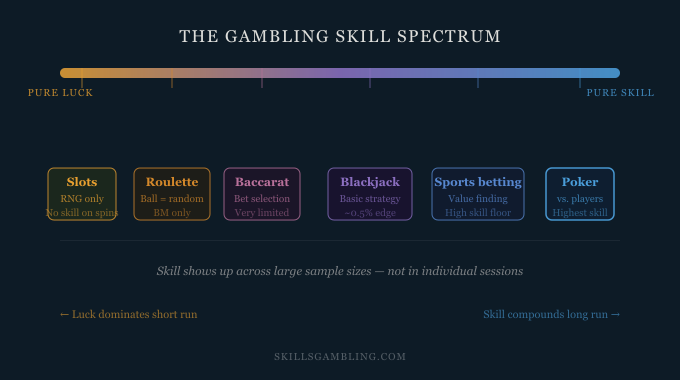
The Skill Spectrum
Think of gambling games on a scale from pure luck to high skill.
| Game | Skill Influence | Primary Skill Element |
|---|---|---|
| Slots | Minimal | Game selection, RTP awareness |
| Roulette | Minimal | Bet selection, bankroll management |
| Baccarat | Very Low | Bet selection only |
| Blackjack | Moderate | Basic strategy, card counting |
| Video Poker | Moderate | Optimal hold strategy |
| Sports Betting | High | Value finding, line analysis |
| DFS | High | Projection modelling, ownership strategy |
| Horse Racing | High | Handicapping, speed figures |
| Poker | Very High | Multi-dimensional decision-making |
No game sits perfectly at either extreme. Even roulette involves some skill in bankroll management. Even the best poker player loses individual hands to worse opponents. The question is always: over thousands of decisions, does skill meaningfully change the long-run trajectory?
Where Luck Lives in Gambling
Luck, in gambling terms, is randomness you cannot control or predict with consistent accuracy.
It shows up as:
- The cards you’re dealt. No strategy controls which cards come out of the deck on any given hand.
- The roulette ball. Each spin is statistically independent of every previous spin.
- Short-run variance. Even in skill games, random outcomes create stretches of good and bad results that have nothing to do with decision quality.
Luck is also responsible for what gamblers call running good or running bad. Two players making identical decisions over the same 500 hands can produce significantly different results purely because of how the cards fell. Over 50,000 hands, those results will converge toward what the math predicts. Skill shows up in the long run. Luck dominates the short run.
This creates one of the most important — and consistently underestimated — challenges in gambling: confirming whether you’re actually skilled is genuinely difficult, because luck creates so much noise in short-term results.
“Most gamblers who think they’ve found an edge are actually just running hot. Most gamblers who think their strategy is broken are just running cold.”
Poker: The Clearest Case for Skill
Poker is the strongest example of skill-based gambling — and the evidence is more robust than most people realise.
Unlike casino games, you’re not competing against the house. You’re competing against other players. The house takes a small rake from each pot, but your long-run results are determined almost entirely by the quality of your decisions versus the quality of your opponents’ decisions.
Where Skill Lives in Poker
- Hand selection — knowing which starting hands to play and which to fold before money goes in
- Positional awareness — understanding that acting last gives you a significant informational advantage
- Reading opponents — identifying betting patterns, tendencies, and likely hand ranges
- Pot odds and expected value — knowing when calling a bet is mathematically justified across a large sample
- Game Theory Optimal (GTO) play — a strategy framework that makes you unexploitable over the long run
- Exploitative play — identifying and targeting specific weaknesses in individual opponents
- Bankroll management — playing stakes appropriate to your bankroll so variance doesn’t eliminate you before skill has time to show
Where Luck Lives in Poker
- The specific cards dealt to you and your opponents on any given hand
- Whether a mathematically correct draw completes or misses
- Short-run variance over sessions, weeks, and even months
The Evidence for Poker Skill
Studies have consistently found that the same players appear at the top of results across thousands of tournament entries and cash game hours. Professional players sustain positive results over careers measured in decades. None of that is possible in a purely luck-based game.
That said, even elite players lose sessions, lose months, and occasionally lose extended periods to variance. The skill only clearly emerges across very large sample sizes.
Blackjack: Real Skill, Realistic Limits
Blackjack occupies the middle ground on the skill spectrum — more skill-influenced than most casino games, but with a lower ceiling than poker.
Against a random player, the house edge in a typical blackjack game runs between 0.5% and 2% depending on rules. A player using basic strategy — the mathematically optimal decision for every possible hand versus every dealer upcard — can reduce that house edge to approximately 0.5% in favourable conditions.
That’s a meaningful difference. A player making intuitive or random decisions loses roughly four times faster than a player using basic strategy. Over long sessions and regular play, skill demonstrably matters.
Basic Strategy
Basic strategy is not complicated. It’s a set of rules that fit on a single chart. Hit here. Stand there. Double down in this spot. Split those pairs. It takes a few hours to learn and can be referenced freely at most casinos.
Learning it properly is the single most impactful thing a blackjack player can do.
Card Counting
Card counting goes further. By tracking the ratio of high to low cards remaining in the shoe, skilled players can identify moments when the deck composition favours the player and increase bets accordingly. This can turn a small house edge into a small player edge — typically around 0.5% to 1% under realistic conditions.
Card counting is legal. Casinos don’t like it and will ask you to leave if they identify you as a counter — but it is not cheating.
The honest caveat: the skill ceiling in blackjack is lower than in poker. You can’t read opponents, you can’t bluff, and even a skilled card counter works with a small edge that requires significant bankroll and volume to realise.
Sports Betting: High Skill, High Bar
Sports betting is skill-based in theory. In practice, most sports bettors lose — because sportsbooks are better at setting lines than most bettors are at beating them.
Skill in sports betting means finding value: situations where your assessment of the probability of an outcome is better than the probability implied by the bookmaker’s odds. This sounds straightforward. It isn’t.
Where Skill Lives in Sports Betting
- Value betting — identifying prices that are better than the true probability warrants
- Line shopping — finding the best available odds across multiple books
- Closing line value — if your bet is at better odds than where the market closes, you’re demonstrating genuine predictive ability
- Statistical modelling — assessing team performance, injuries, situational factors, and matchup dynamics more accurately than market pricing already reflects
- Bankroll management — staking proportional to your edge, not your confidence or enthusiasm
Where Luck Lives in Sports Betting
- Every individual event outcome — even the best model is wrong regularly
- Injury timing, referee decisions, weather effects
- Short-run variance over weeks and months
The Practical Challenge
Sportsbooks employ sophisticated analysts and adjust lines based on where sharp (professional) money is placed. The market is efficient. Recreational bettors who rely on intuition and team loyalty reliably lose over time — not because sports betting is pure luck, but because casual analysis rarely finds genuine edge against a professional market.
Daily Fantasy Sports: Skill Classification Is Deserved
DFS platforms like DraftKings and FanDuel have been legally classified as games of skill in most jurisdictions — and the data supports that classification.
The top DFS players run sophisticated projection models and lineup optimisation tools. The same names appear repeatedly at the top of high-stakes contests. That pattern doesn’t emerge in luck games.
Where Skill Lives in DFS
- Salary cap optimisation — building lineups that maximise projected output within budget constraints
- Ownership analysis — identifying underowned players relative to their projected value to differentiate tournament lineups
- Matchup analysis — defensive weaknesses, game pace projections, weather impacts on outdoor sports
- Projection modelling — forecasting player performance using historical data and contextual factors
Variance in any given week is enormous. Even excellent lineups finish poorly when key players underperform. Long-run skill shows up in ROI measured across hundreds or thousands of contests — not in individual weeks.
Horse Racing: One of the Oldest Skill Markets
Handicapping horse racing is a genuine skill — and one of the oldest forms of analytical gambling in existence.
Professional horseplayers analyse:
- Speed figures — standardised measures of how fast each horse has run, adjusted for track conditions and distance
- Form — recent performance, workout times, jockey and trainer patterns
- Class — whether a horse is moving up or down in competition level
- Pace — how the race is likely to develop based on each horse’s running style
- Value — whether market odds correctly price each horse’s actual winning probability
The parimutuel betting system means you’re competing against other bettors for the pool, not against a fixed house edge. Consistently assessing horses more accurately than the average bettor is theoretically profitable. The practical difficulty: the market includes sophisticated professionals who also push prices toward efficiency.
Where Skill Barely Moves the Needle
Roulette
Roulette is, mathematically, a pure luck game.
The outcome of each spin is random and statistically independent. No betting system — Martingale, Fibonacci, D’Alembert, or anything else — changes the house edge. European roulette carries a house edge of 2.7%. American roulette (double zero) carries 5.26%. No pattern, progression, or system removes that.
Skill in roulette is limited to:
- Game selection — always choosing European over American roulette reduces the house edge by almost half
- Bet selection — understanding which bets carry different risk profiles (though they all carry the same house edge per unit wagered)
- Bankroll management — understanding variance so you don’t deplete your bankroll before the session you planned
Anyone claiming a consistent roulette winning system is either selling something or misunderstanding variance.
Slots
Modern video slots are purely luck-based outcomes governed by Random Number Generators certified by independent testing bodies.
Skill in slots is limited to:
- RTP selection — choosing machines with higher Return to Player percentages. A 97% RTP machine returns more per pound wagered than a 92% RTP machine over volume
- Volatility matching — high-volatility slots pay less frequently but in larger amounts; choosing the right volatility for your bankroll is a genuine decision
- Bonus feature decisions — some modern slots include interactive bonus rounds where choices affect outcomes
Nothing changes the fundamental RNG result on any individual spin.
Baccarat
Baccarat is almost entirely a luck game. The only player decision is which of three bets to place.
- Banker bet: ~1.06% house edge ✓
- Player bet: ~1.24% house edge
- Tie bet: ~14% house edge ✗
Once you’ve learned to always bet Banker and never bet Tie, you’ve extracted everything skill can offer in baccarat. The card outcomes themselves are entirely random. No betting system or pattern changes that.
The Myth of Betting Systems
“Betting systems don’t create an edge. They redistribute wins and losses — and then the house edge takes its cut regardless.”
Progressive betting strategies like the Martingale are frequently marketed as skill-based approaches to luck games. They aren’t.
The Martingale requires doubling your bet after each loss, theoretically recovering all previous losses when you eventually win. The logic is seductive because losing streaks do eventually end.
The problem is table limits and finite bankrolls. A run of eight consecutive losses — which happens regularly in any game with reasonable variance — requires a bet 256 times your original stake on the ninth hand. Most players hit table limits or bankroll limits long before recovery arrives.
Across millions of simulations, the Martingale and all similar progressions produce the same long-run result as flat betting. The house edge is unchanged. Systems redistribute wins and losses but cannot remove the underlying mathematical disadvantage.
In skill games, bankroll management is a genuine skill — but it operates through rational stake sizing proportional to edge, not mechanical progressions.
Pros and Cons: Skill-Based Gambling vs Pure Luck Games
| Skill-Based Games | Pure Luck Games | |
|---|---|---|
| Can improve with practice | Yes | No |
| Long-run results reflect decisions | Yes | No |
| House edge can be reduced | Yes (blackjack, poker) | No |
| Short-run results are predictable | No | No |
| Learning curve required | Yes | No |
| Bankroll management matters | Critically | Moderately |
| Variance can be painful | Yes | Yes |
| Professional earnings possible | Yes (rare) | No |
Expert Insight: What Separates Long-Run Winners from Everyone Else
Professional gamblers — the ones who actually sustain positive results over years — share consistent characteristics regardless of which game they specialise in.
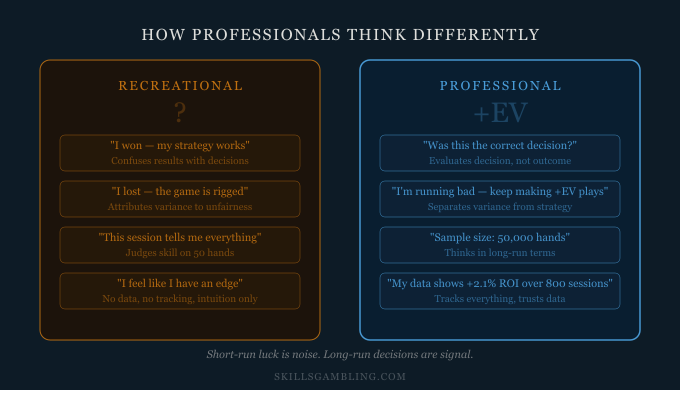
They understand expected value. Every decision is evaluated not on whether it wins this time, but on whether it wins money over thousands of identical situations. A call that loses 40% of the time but wins 60% is a good call every single time it’s made, regardless of the outcome of this particular hand.
They separate decision quality from results. A good decision that produces a bad outcome is still a good decision. A bad decision that happens to win is still a bad decision. This is harder to internalise than it sounds, but it’s the foundation of professional thinking.
They manage variance honestly. The best poker players in the world have lost money for six-month stretches. They manage it through proper bankroll sizing and the discipline to continue making correct decisions during losing periods.
They track everything. Professionals keep detailed records because variance makes short-term results actively misleading. Data over time is the only honest measure of whether skill is producing results.
They continuously adapt. Games evolve. Sports betting markets become more efficient as more sophisticated participants enter. Poker strategies shift as player pools adapt. Professionals treat their edge as something that requires ongoing maintenance.
Responsible Gambling
Understanding skill and luck in gambling is educational. It doesn’t change the fundamental reality that gambling carries real financial risk.
No gambling strategy guarantees profit. Even in skill games, outcomes are uncertain. Even the best poker players, sports bettors, and handicappers experience significant losing periods. Past performance does not predict future results.
Gambling should be approached as entertainment, not as income. The skill element in certain games makes them more intellectually engaging and can reduce the rate at which you lose over time — but it doesn’t eliminate risk.
If gambling stops feeling like entertainment and starts feeling like a financial necessity, that’s a signal worth taking seriously. Most regulated gambling jurisdictions provide access to deposit limits, session time limits, cooling-off periods, and self-exclusion programmes. These tools exist, they’re free to use, and they work.
FAQ
Is poker a game of skill or luck?
Poker is primarily a game of skill over the long run. Individual hands involve significant luck — any two cards can win a specific hand against any other two cards. But across thousands of hands, better decision-making consistently produces better results. The same skilled players appear repeatedly at the top of tournaments and cash games over careers spanning years, which is not possible in a purely luck-based game.
Can skill beat the house edge?
In most games, no. The house edge is a mathematical certainty in roulette, slots, and baccarat. In blackjack, basic strategy reduces the house edge to approximately 0.5% in good conditions, and card counting can produce a small theoretical player edge. In poker, you’re not playing against a house edge — you’re playing against other players. In sports betting, a small number of professionals with genuine analytical edge do beat implied margins over time.
Does basic strategy actually help in blackjack?
Yes, substantially. A player making intuitive decisions in blackjack faces a house edge of around 2–4% depending on rules and decisions. A player using mathematically correct basic strategy reduces that to approximately 0.5%. That difference compounds significantly over extended play. It’s the single highest-impact skill improvement available in any casino table game.
Why do people lose at skill games if skill matters?
Because skill influences results gradually over large sample sizes, and most recreational players don’t play enough volume for skill to clearly outpace variance. Additionally, many players overestimate the quality of their own decisions. Genuine skill requires ongoing study, honest self-assessment, and detailed record-keeping — not just confidence.
Is sports betting a skill game?
Yes — but most sports bettors lose because the market is more accurate than casual analysis. Consistently profitable sports betting requires a genuine edge over sportsbook pricing, which is rare and requires significant analytical effort to develop and sustain.
Are betting systems like the Martingale useful?
No. Progressive betting systems do not change the house edge in any game. They redistribute wins and losses across a session but produce identical long-run results to flat betting. In pure luck games, no staking system overcomes the mathematical disadvantage built into the game.
What are the most skill-intensive gambling games?
Poker, sports betting, and horse racing handicapping are generally the most skill-intensive. DFS carries a substantial skill component. Blackjack and video poker involve meaningful but more limited skill — basic strategy and optimal hold decisions respectively. Roulette, baccarat, and standard slots involve minimal skill influence on outcomes.
Conclusion
The skill vs luck question in gambling is not a binary — it’s a spectrum, and knowing where each game sits on that spectrum is one of the most practically useful pieces of knowledge a gambler can have.
In pure luck games, the most skilful decision you make is understanding the odds, choosing the right variant, managing your bankroll, and accepting that short-term results tell you nothing meaningful.
In skill games, decision quality matters enormously over the long run — but the long run is longer than most people expect, variance is more disorienting than most people anticipate, and the skill required is harder to develop than most gambling content will admit.
Anyone claiming otherwise — in either direction — is oversimplifying for an audience that deserves better.
Related Reading
- What Is Expected Value in Gambling?
- Blackjack Basic Strategy: The Complete Chart
- What Is House Edge and How Does It Work?
- Bankroll Management: How to Protect Your Money
- Value Betting in Sports: A Plain-English Guide
No gambling strategy guarantees profit. All gambling involves financial risk. Past performance does not predict future results. If you’re concerned about your gambling, contact your local responsible gambling support service or use the tools available through your gambling provider.