
Quick Answer
Expected value (EV) is the average result of a bet if you made it an infinite number of times. A bet with positive expected value (+EV) makes money over the long run. A bet with negative expected value (−EV) loses money over the long run. Most casino bets are −EV — the house edge is simply the casino’s built-in positive expected value on every wager. In poker and sports betting, skilled players find and exploit +EV situations. Every decision a professional gambler makes is rooted in this single concept.
Introduction
Most gamblers make decisions based on one of two things: gut feeling, or recent results.
“I’m on a run — keep going.” “That number hasn’t come up in ages — it’s due.” “I just feel good about this one.”
None of those tell you anything reliable about whether a bet is worth making. None of them will save you money over ten thousand bets. None of them are what professionals actually use.
Expected value is what replaces all of that. It’s the tool that turns gambling from guesswork into analysis. It’s the foundation of every decision serious poker players make, every line a professional sports bettor evaluates, and every basic strategy play in blackjack.
Once you understand it, you stop asking “will I win?” and start asking “is this bet worth making?” Those are completely different questions — and only one of them matters in the long run.
What Expected Value Actually Means
Here’s the core idea, stated plainly:
Expected value is what a bet is worth on average, across a very large number of identical bets under identical conditions.
It’s not a prediction about the next outcome. It’s a statement about the long-run average if you made the same bet thousands of times.
A simple example makes this immediate.
You flip a fair coin. Heads wins you £1. Tails loses you £1.
- Probability of winning: 50% → outcome: +£1
- Probability of losing: 50% → outcome: −£1
EV = (0.5 × £1) + (0.5 × −£1) = £0.50 − £0.50 = £0
The expected value is zero. This is a perfectly fair game — neither side has an edge. Over a million flips, you’d expect to break roughly even.
Now shift the terms. Same coin, but heads wins £0.90 and tails loses £1.
EV = (0.5 × £0.90) + (0.5 × −£1) = £0.45 − £0.50 = −£0.05
Now you expect to lose 5p for every £1 you put in. That’s negative EV — and it’s structurally identical to how a casino game with a 5% house edge works against players.
The casino sitting on the other side has an EV of +£0.05 per flip. The house edge is simply the casino’s positive expected value, expressed as a percentage of every bet you make.
The EV Formula
You don’t need advanced maths to use expected value. The formula covers every scenario:
EV = Σ (probability of outcome × value of outcome)
Which means: for each possible result, multiply its probability by what it’s worth, then add everything together.
The sign of the result tells you everything:
| Result | Meaning |
|---|---|
| Positive EV (+EV) | Profitable over time — you expect to make money |
| Zero EV | Break-even — neither side has an edge |
| Negative EV (−EV) | Losing over time — you expect to lose money |
The size of the EV tells you the rate of gain or loss per unit bet — not whether you’ll win the next individual bet.
EV in Real Gambling Situations
Theory only matters if it maps onto what actually happens at the table or on the betting app. Here’s how expected value works across the major gambling contexts.
Roulette: A Textbook −EV Example
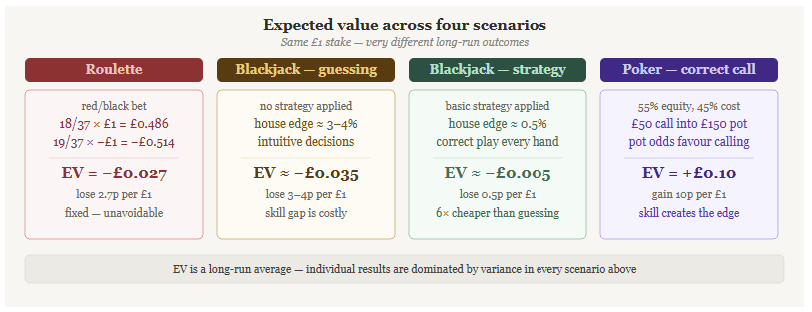
European roulette has 37 pockets. You bet £1 on red (18 red numbers out of 37).
- Probability of winning: 18/37 = 48.65%
- Amount won: £1
- Probability of losing: 19/37 = 51.35%
- Amount lost: £1
EV = (0.4865 × £1) − (0.5135 × £1) = −£0.027
Every £1 bet on red loses 2.7p on average over time. That’s the European roulette house edge expressed as expected value. The single zero pocket — which pays nothing to players betting red or black — is precisely where the 2.7p comes from.
No bet in European roulette has positive expected value for the player. The zero pocket creates the same −2.7% EV on every single bet type — straight numbers, colours, dozens, everything. The bets feel different because they have different variance. The expected value is identical.
American roulette adds a double zero, taking the EV to −5.26% per bet. The payout structure doesn’t change. You’re simply giving the house a bigger cut on every wager.
Blackjack: Where Decisions Change Your EV
Blackjack is the casino game where your decisions directly and materially change your expected value on every hand. This is what makes it different from every fixed-odds game.
A player making random or intuitive decisions at a standard blackjack table faces an EV of roughly −3% to −4% per hand. A player applying mathematically correct basic strategy reduces that EV to approximately −0.5% under good rule conditions.
That gap — 2.5–3.5% of every bet, every hand — compounds enormously over any serious volume of play. At £25 per hand, 60 hands per hour, over four hours:
- £6,000 wagered
- Random player at −3% EV: expected loss £180
- Basic strategy player at −0.5% EV: expected loss £30
Same game. Same stakes. Same session length. The difference is purely in decision quality.
Consider a specific hand: you hold a hard 16, dealer shows a 6.
- Standing: EV ≈ −£0.42 per £1 bet (less negative — dealer likely to bust)
- Hitting: EV ≈ −£0.54 per £1 bet (you risk busting unnecessarily)
Standing is correct — not because you’ll win, but because it’s the less negative EV choice. Basic strategy is nothing more than the complete map of which decision produces the best EV in every possible hand situation. Every deviation from it is a voluntary reduction in your expected value.
Poker: Competing for EV Against Other Players
Poker has a fundamentally different EV structure from every casino game. You’re not playing against a fixed mathematical house edge. You’re competing against other players, and the casino takes a rake (typically 2–10% per pot, usually capped) as its fee.
Your long-run results are determined by the gap between your decision quality and your opponents’ decision quality, minus rake. A player whose decisions are consistently better than their competition’s can sustain positive EV — which is mathematically impossible in roulette or baccarat regardless of strategy.
Here’s a practical poker EV calculation. You’re on the turn with a flush draw. Your opponent bets £50 into a £100 pot.
Step 1 — Your equity: A flush draw with one card to come hits roughly 19% of the time (9 outs ÷ 47 remaining cards).
Step 2 — Pot odds: After your call, the pot will be £200. Your call costs £50. You’re paying 25% of the pot to call.
Step 3 — Compare: Your winning probability (19%) is less than your cost as a proportion of the pot (25%).
EV of calling = (0.19 × £150) − (0.81 × £50) = £28.50 − £40.50 = −£12.00
The call is −EV by £12. Folding is correct.
If the pot were larger — say your opponent bet £20 into a £200 pot — the call costs £20 into a £220 pot (9%). Your 19% equity now exceeds your 9% cost. The call becomes strongly +EV.
This is why pot odds and equity are the two concepts every poker player needs to internalise. Every call, raise, and fold is an EV calculation. Good players make the +EV decision consistently — and accept that short-run results don’t validate or invalidate that.
Sports Betting: Finding +EV in Mispriced Odds
In sports betting, the bookmaker’s overround (vig) creates a built-in negative EV on every market — typically 4–10% depending on the sport and book. To find positive EV, your probability estimate of an outcome must be more accurate than the implied probability baked into the odds.
A bookmaker offers 3.20 (decimal) on a football team winning. Implied probability: 1 ÷ 3.20 = 31.25%.
Your analysis suggests the team’s true probability is 42%.
EV = (0.42 × £2.20 profit) − (0.58 × £1 stake) = £0.924 − £0.58 = +£0.344
Expected value: +34.4p per £1 staked, if your probability estimate is correct.
If. That qualifier is the entire challenge of sports betting. The calculation is only as good as the probability you feed into it. Overestimate your team’s chances and what looks like +EV is actually −EV in reality. The discipline of forming accurate probability estimates — independently of what the odds suggest — is where genuine sports betting skill lives. For a full breakdown of how to find and measure this edge, see our guide to value betting and closing line value.
EV and Variance: The Most Important Relationship in Gambling
Understanding expected value is only half the picture. The other half is understanding what it doesn’t tell you.
Expected value is a long-run average. It says nothing about any individual outcome.
A bet with +14% EV loses 48% of the time. A blackjack hand played perfectly still loses more hands than it wins in many situations. A poker player making consistently +EV calls will still experience losing stretches lasting weeks, months, and occasionally longer.
This is variance — the natural randomness of outcomes that creates the gap between short-run results and long-run expectation. It doesn’t invalidate EV thinking. It makes it more essential.
“The hardest thing about expected value is trusting it when you’re losing. The short-run noise is so loud that the long-run signal feels invisible. But the signal is there — and it’s the only thing that matters.”
The practical implication is significant:
- A winning session doesn’t confirm good decisions. You could be making −EV plays and running hot on variance.
- A losing session doesn’t mean your decisions are wrong. You could be making +EV plays and running cold on variance.
- The only reliable measure of decision quality is EV — not results.
This is why professional gamblers talk about process rather than outcomes, and why they track thousands of decisions before drawing conclusions. Variance creates too much noise in any small sample for results alone to be meaningful.
Why Betting Systems Don’t Change EV
The Martingale is the most famous betting system: double your stake after every loss, so when you eventually win, you recover all previous losses plus a small profit.
It sounds logical. It fails mathematically — and EV explains exactly why.
Each individual bet in roulette has an EV of −2.7% regardless of size. Doubling after a loss creates a new, larger bet — with the same −2.7% EV. You haven’t changed the EV of any individual bet. You’ve just made some bets bigger.
EV of Martingale sequence = sum of EV of each individual bet = still negative
The system changes how losses accumulate — more frequent small wins, occasional catastrophic losses when a losing streak exceeds your bankroll or the table limit. But it does not change the expected value of any bet, or the total expected value across any number of bets.
This applies to every progressive staking system ever devised. The expected value of a series of −EV bets in any sequence or pattern is still negative. You cannot rearrange negative numbers into a positive total.
Positive EV vs Negative EV: A Reference Table
| Bet / Situation | EV Direction | Why |
|---|---|---|
| European roulette, any bet | −EV | 2.7% house edge on all bets |
| American roulette, any bet | −EV | 5.26% — double zero adds extra house margin |
| Baccarat, Banker bet | −EV (small) | 1.06% house edge — lowest in fixed-odds casino games |
| Baccarat, Tie bet | −EV (large) | ~14% house edge — should always be avoided |
| Slots (any spin) | −EV | 2–15% house edge depending on RTP |
| Blackjack (random play) | −EV (large) | ~3–4% house edge |
| Blackjack (basic strategy) | −EV (small) | ~0.5% — reduced but not eliminated |
| Blackjack (card counting, favourable count) | +EV | Deck composition temporarily favours player |
| Poker call with correct pot odds | +EV | Your equity exceeds your cost as proportion of pot |
| Poker call with incorrect pot odds | −EV | Paying too much relative to your winning probability |
| Sports bet at market odds | −EV | Overround built into every line |
| Sports bet where your probability > implied probability | +EV | You’ve identified a mispriced outcome |
| Martingale or any progressive system | −EV | System changes bet sizing, not expected value |
How Professionals Use EV: A Different Way of Thinking
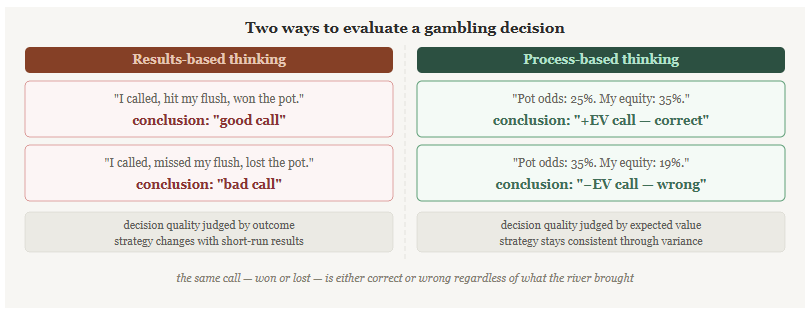
The shift from casual to professional gambling thinking is, at its core, a shift from results-based thinking to process-based thinking.
Results-based thinking: “I won — that call was right.” “I lost — I should have folded.”
Process-based thinking: “Was that call +EV given my estimate of their range and the pot odds? Yes. Then it was the right call, regardless of what the river brought.”
This distinction sounds subtle. Over thousands of decisions, it produces completely different outcomes. The results-based thinker adjusts their strategy based on recent luck — chasing losses, abandoning correct plays that haven’t been working lately, doubling down on strategies that happened to win. The process-based thinker maintains consistent +EV decision-making through variance, because they understand that the decision quality and the short-run result are two different things.
“Every bet is a policy, not a prediction. When you decide to call that raise, you’re not deciding about this hand. You’re deciding what to do every time this situation comes up for the rest of your gambling life. Is that policy +EV?”
Four habits that separate EV-based gamblers from everyone else:
- They track decisions, not just results. Spreadsheets, session logs, bet records — data is the only honest way to distinguish skill from variance over time.
- They calculate before they act. Pot odds, implied probability, equity estimates — approximate but done, every significant decision.
- They accept short-run losses without changing their approach. A losing month doesn’t mean the strategy is wrong. It means variance is doing what variance does.
- They size bets proportionally to edge, not confidence. Larger edge = larger stake, according to explicit rules — not according to how certain they feel right now. For the maths behind optimal staking, the Kelly Criterion research from Wharton School is the most practical published framework available.
The Gambler’s Fallacy and EV
The gambler’s fallacy is the belief that past outcomes in independent random events influence future probabilities.
“Red has come up six times in a row — black is due.”
It isn’t. Each spin is independent. The probability of red or black on the next spin is the same 48.65% it always is, regardless of the previous ten results. The wheel has no memory. Previous outcomes carry zero predictive weight for future ones.
This matters directly for EV: the expected value of a roulette bet is −2.7% whether red has come up twice in a row or twelve times. The EV of the next bet is identical in both cases — because EV is derived from fixed probabilities, and those probabilities don’t change based on history.
Peer-reviewed research published through NIH found that susceptibility to the gambler’s fallacy was positively correlated with general intelligence and executive function — meaning smarter people are more prone to it, not less, when relying on intuition rather than mathematical reasoning. The fix is not to be smarter. The fix is to do the EV calculation rather than trusting the feeling.
Applying EV Practically: What to Do Differently
Understanding EV is only useful if it changes how you make decisions. Here’s what it should change:
At the casino table:
- Learn basic strategy before playing blackjack. The EV gap between informed and uninformed play is 1.5–3.5% of every bet. At any serious stakes, that’s the highest-impact learnable skill available in a casino environment.
- Always choose European over American roulette. −2.7% EV beats −5.26% EV. There is no compensating advantage in the American version.
- Avoid the Tie bet in baccarat. Its −14% EV versus the Banker bet’s −1.06% is not a matter of preference — it’s a mathematical fact.
- Check RTP on slots before playing. A 97% RTP machine has −3% EV per spin. A 92% RTP machine has −8% EV. Same entertainment, meaningfully different maths.
In poker:
- Estimate pot odds on every significant call. You don’t need precision — a rough comparison of your equity to your call cost as a proportion of the pot is enough to identify clearly +EV or −EV decisions.
- Separate your decision from the result. Review whether your decision was correct before you look at whether it won. This is the habit that compounds into skill over time.
In sports betting:
- Form your probability estimate before looking at the odds. Seeing the price first anchors your thinking. Independent probability assessment requires removing that anchor.
- Track closing line value on every bet. Whether you consistently beat the closing price is a faster, more reliable signal of genuine +EV than results over any short period.
Pros and Cons: EV as a Decision Framework
| Benefit | Challenge |
|---|---|
| Makes decisions rational and consistent | Requires accepting short-run losses without abandoning the approach |
| Provides an objective measure of bet quality | Exact EV calculation is difficult in complex situations (poker reads, sports modelling) |
| Exposes the true cost of every casino game | Does not predict short-run results |
| Works across every form of gambling | Probability estimates in sports betting can be wrong — bad inputs produce bad EV calculations |
| Separates good decisions from lucky outcomes | Requires patience — EV only becomes clearly visible over large samples |
| Identifies where skill genuinely creates edge | Most casino games offer no +EV path regardless of skill |
Responsible Gambling
Expected value is a mathematical tool. Understanding it does not change the fundamental nature of gambling as a financially risky activity.
Most gambling bets are negative EV. Even in skill games like poker and sports betting, sustaining positive EV over the long run requires a level of expertise that takes significant time and effort to develop — and is not guaranteed even then. Variance means losses are inevitable even for skilled players, and the psychological pressure of losing streaks is real regardless of whether the underlying decisions are correct.
Gambling should remain entertainment within clearly defined financial limits. No EV analysis changes the risk of financial harm when stakes exceed what you can genuinely afford to lose.
If gambling is generating financial stress, influencing decisions outside of gambling, or feeling compulsory rather than recreational, that’s a signal worth taking seriously. Deposit limits, session limits, time-outs, and self-exclusion are available through all regulated gambling providers — free, immediate, and effective.
FAQ
What does expected value mean in gambling?
Expected value is the average result of a bet if you placed it an infinite number of times under identical conditions. A positive EV bet makes money over time. A negative EV bet loses money over time. Most casino bets are negative EV — the house edge is the casino’s positive expected value built into every wager. In skill games like poker and sports betting, positive EV is achievable for players who make better decisions than their opponents or the market.
How do you calculate expected value on a bet?
Multiply the probability of winning by the amount you’d win, then subtract the probability of losing multiplied by the amount you’d lose. EV = (probability of winning × profit) − (probability of losing × stake). If the result is positive, the bet has positive expected value. If negative, it’s a losing bet over time.
Can a −EV bet still win?
Yes, frequently. Expected value is a long-run average — individual results are dominated by variance. A bet with −5% EV wins roughly half the time on an even-money market. The expected value only becomes the determining factor across thousands of bets. Short-run wins on −EV bets don’t validate the decision; short-run losses on +EV bets don’t invalidate it.
Why is poker different from other casino games for EV?
In poker, you compete against other players rather than a fixed mathematical house edge. The casino takes a rake, but your long-run results depend on the gap between your decision quality and your opponents’ — not on an immovable built-in disadvantage. A player whose decisions are consistently better than their competition’s can sustain positive EV over time. This is mathematically impossible in roulette, baccarat, or slots regardless of strategy.
Do betting systems like the Martingale improve expected value?
No. Every individual bet in a negative-EV game carries the same negative expected value regardless of stake size. The Martingale doubles the bet after losses — creating larger bets with the same negative EV. The system changes how wins and losses are distributed across a session, but leaves the total expected value unchanged. The sum of a series of negative-EV bets in any sequence is still negative.
How many bets do you need before EV becomes visible in your results?
Typically thousands. At a 5% ROI in sports betting, you’d need approximately 1,000+ bets before your results become statistically distinguishable from a break-even bettor at 95% confidence. In poker, tens of thousands of hands are required before win rates stabilise meaningfully. This is why tracking closing line value in sports betting and long-run session data in poker matters — they provide better signals than results alone at lower sample sizes.
Is it possible to find positive EV in casino games?
In most casino games, no — the house edge creates an immovable mathematical disadvantage. The narrow exceptions: blackjack card counting can theoretically produce a small player edge (0.5–1%) under favourable conditions, and video poker with optimal strategy approaches near-zero house edge. Both require precise skill and significant volume before the edge becomes practically meaningful. For the full analysis including how basic strategy and card counting change the maths, see our dedicated skill vs house edge guide.
Conclusion
Expected value is the single most important concept in gambling analysis — and one of the least understood outside professional circles.
It doesn’t tell you whether you’ll win the next bet. It tells you whether the bet is worth making — whether the price is right, whether the decision is justified, whether you’re on the right side of the maths over time.
Most gambling bets are negative EV. That’s not a scandal — it’s the price of the entertainment, and knowing the price is valuable. For casino games with fixed odds, EV tells you exactly what each session costs you in mathematical expectation. For skill games — poker, sports betting, blackjack with counting — EV is the tool that separates decisions made on analysis from decisions made on feeling.
The bettors and players who use it consistently don’t win every session. They lose plenty. What they do is make decisions they can defend mathematically — and over tens of thousands of decisions, the expected value they’ve accumulated gradually separates them from everyone guessing in the dark.
That gap is what skill in gambling actually looks like.
Related Reading
- What Is the House Edge and How Does It Work?
- Can Skill Overcome the House Edge? A Game-by-Game Analysis
- Skill vs Luck in Gambling: Where the Line Actually Falls
- Value Betting in Sports: Finding Edge Against the Market
- Bankroll Management: Protecting Your Money Over the Long Run
- How Professional Gamblers Think Differently
External Sources:
- Wharton School — Betting Strategy and Kelly Criterion Research
- NIH/PubMed — The Gambler’s Fallacy and Decision Making
- University of Chicago — A Probabilistic View on the Economics of Gambling
No gambling strategy guarantees profit. All gambling carries financial risk. Past performance does not predict future results. If you have concerns about your gambling, please use the responsible gambling tools available through your provider or contact your local support service.