
Quick Takeaways
- Blackjack betting systems manage how much you wager — they don’t change the odds of winning any individual hand.
- Systems fall into two broad camps: positive progression (increase bets after wins) and negative progression (increase bets after losses).
- No system eliminates the house edge. Maths is maths, regardless of how bets are structured.
- The right system depends on your bankroll, risk appetite, and what you actually want from a session.
- Basic strategy — knowing when to hit, stand, split, and double — should always come before any betting system.

Introduction
Walk into any blackjack forum, sit at any table long enough, and you’ll hear players discussing their system. The Martingale. The Paroli. The Fibonacci. People talk about them the way golfers discuss grip technique — with complete conviction that the right method makes all the difference.
There’s something to that, and something not to. Blackjack betting systems are real tools, used by millions of players worldwide, and understanding how they work will make you a sharper, more composed player at the table. What they won’t do is turn blackjack into a guaranteed money-maker. The house edge doesn’t disappear because you double after a loss.
This guide covers the major blackjack betting systems in plain terms — how each one works, what it costs in practice, and who it actually suits. By the end, you’ll know enough to choose a system with your eyes open rather than your hopes up.
What Are Blackjack Betting Systems?
A betting system is a structured set of rules that tells you how much to wager on each hand, typically based on whether you just won or lost. It sits on top of your playing decisions — it doesn’t replace them.
This distinction matters. Playing strategy (sometimes called basic strategy) governs how you play each hand: when to hit, when to stand, when to double down, and when to split. It’s built on probability and, used correctly, reduces the house edge to as low as 0.5% in favourable rule sets. That’s your foundation.
A betting system governs how much you wager. It doesn’t touch the probability of any individual hand, because each hand in blackjack is essentially independent. The cards don’t know you lost the last five in a row.
So why use one? A few legitimate reasons:
- Session structure. A system gives you clear rules to follow, which takes emotion out of the equation. You’re not improvising after a bad run.
- Bankroll pacing. Certain systems can help your money last longer by controlling how aggressively you bet.
- Capitalising on streaks. Positive progression systems attempt to wring more value out of winning runs.
None of these benefits override variance or the house’s mathematical advantage. But used sensibly, a betting system can make your sessions more disciplined — and that’s worth something.
Positive vs Negative Progression: The Core Distinction
All betting systems come down to one question: when the previous hand is resolved, do you go up or down?
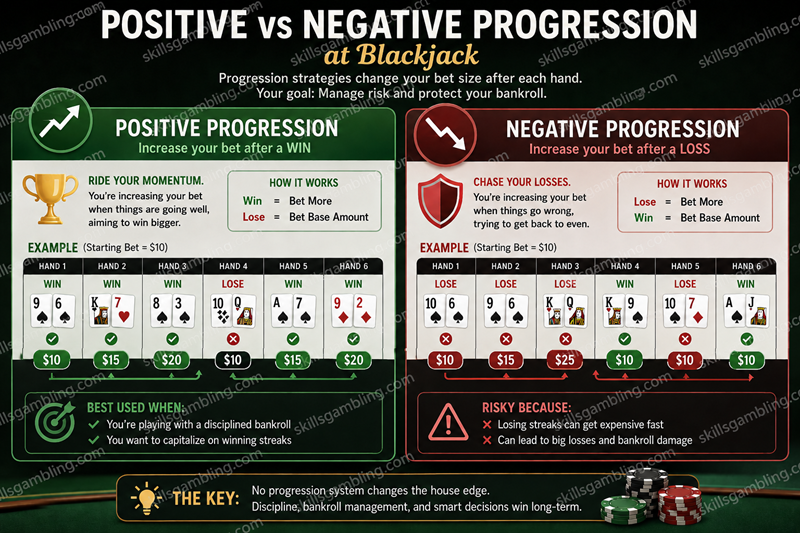
Positive progression systems tell you to increase your bet after a win and reduce or reset after a loss. The idea is to ride hot streaks while limiting damage during cold ones. You’re pressing when the table’s going your way, not when it isn’t.
Negative progression systems do the opposite — you increase your bet after a loss, trying to recover previous losses with a single larger win. These systems often feel logical in theory (you must win eventually), but they carry serious financial risk during extended losing runs.
Flat betting is technically neither — you wager the same amount on every hand, regardless of what happened last. It’s the most conservative approach and worth understanding in its own right.
| Category | Increase bets after… | Core logic | Risk profile |
|---|---|---|---|
| Positive progression | Wins | Maximise winning streaks | Low to moderate |
| Negative progression | Losses | Recover losses quickly | Moderate to high |
| Flat betting | Neither (bet stays the same) | Consistency and longevity | Low |
Negative Progression Systems
These systems share a common belief: that a winning hand will eventually arrive, and when it does, the increased bet size will recover previous losses. In practice, the danger lies in extended losing runs, which can escalate bets to uncomfortable — or unsustainable — levels.
The Martingale System
The Martingale is the most widely known betting system in casino gambling, applied across blackjack, roulette, and beyond. The rule is simple: double your bet after every loss, and return to your starting bet after a win.
The logic runs like this — if you keep doubling, one winning hand will recover all your losses and deliver a profit equal to your original stake. That’s mathematically true, provided three conditions hold: you have unlimited funds, the casino has no table maximum, and losing streaks never get long enough to break you.
None of those conditions reliably hold in practice.
How it looks in action:
| Hand | Bet | Result | Running total |
|---|---|---|---|
| 1 | £10 | Loss | -£10 |
| 2 | £20 | Loss | -£30 |
| 3 | £40 | Loss | -£70 |
| 4 | £80 | Loss | -£150 |
| 5 | £160 | Win | -£150 + £160 = +£10 |
A five-hand losing streak starting from a £10 base requires a £160 bet just to come out £10 ahead. Losing ten hands in a row — not as rare as it sounds — would require a tenth bet of £5,120 to recover from a £10 starting point.
Most blackjack tables carry a maximum bet limit that caps this progression well before it can complete. When that limit is hit, the system breaks entirely, and losses become unrecoverable through doubling.
Who it suits: Players with a large bankroll, short session goals, and the discipline to walk away once a target is reached. It is not a long-term strategy, and it should not be approached by anyone operating near their financial limits. Players should set strict loss limits before beginning and treat the system as a session management tool, nothing more.
The D’Alembert System
The D’Alembert is a gentler version of negative progression — named after the 18th-century French mathematician Jean le Rond d’Alembert, who had some questionable ideas about probability but gave gambling a serviceable tool in the process.
The rule: increase your bet by one unit after a loss, and decrease it by one unit after a win. This creates a slow, stepped progression rather than the sharp doubling of the Martingale.
How it looks with a £10 unit:
- Start: £10
- Loss → £20
- Loss → £30
- Win → £20
- Win → £10
- Win → back at minimum
The D’Alembert feels safer than the Martingale because the escalation is gradual. And it is, to a point. The problem arrives in sustained losing runs, where bets creep steadily upwards without the step-change recovery that doubling provides. If you lose eight hands and win eight, you don’t necessarily break even — the order matters, and the D’Alembert can leave you behind if wins come earlier in the sequence.
Who it suits: Players who want some loss-chasing structure without the dramatic risk of Martingale. It’s more patient, lower-stakes in its escalation, and easier to absorb psychologically during a bad run.
The Fibonacci System
The Fibonacci system uses the famous mathematical sequence — 1, 1, 2, 3, 5, 8, 13, 21 — to determine bet sizes after losses. Each number is the sum of the two before it. After a loss, you move one step forward in the sequence. After a win, you move back two steps.
Applied to a £10 unit:
- Start at 1 unit (£10)
- Loss → 1 unit (£10) — second number in sequence
- Loss → 2 units (£20)
- Loss → 3 units (£30)
- Win → step back two → 1 unit (£10)
The Fibonacci recovers losses more gradually than the Martingale, which appeals to players who find the doubling model too aggressive. The downside is that a long losing run walks you far up the sequence before any single win brings meaningful recovery, and stepping back two positions means multiple wins are needed to fully reset after a bad patch.
Who it suits: Players comfortable with a structured, mathematically derived approach who want something between the Martingale’s aggression and the D’Alembert’s conservatism. Requires careful tracking of where you are in the sequence.
The Labouchère System
The Labouchère (also called the cancellation system) is the most involved of the negative progression group. You start by writing down a sequence of numbers — for example, 1-2-3-4 — and your bet for each hand equals the sum of the first and last number in the sequence.
If you win, cross off those two numbers. If you lose, add the losing bet total to the end of the sequence. Continue until all numbers are crossed off, at which point you’ve achieved a profit equal to the sum of your original sequence.
Example with the sequence 1-2-3-4:
- First bet: 1 + 4 = £50 (using £10 units, so 5 units)
- Win → cross off 1 and 4 → sequence becomes 2-3
- Bet: 2 + 3 = £50 → Win → sequence complete → profit = £100
This works as described in manageable runs. Where it breaks down is under a sustained losing run, which causes the sequence to grow longer and longer, pushing bets higher and the end point further away.
Who it suits: Organised, mathematical players who find the sequence-tracking approach engaging rather than burdensome. Requires discipline and a clear plan for when to stop if the sequence grows to an unmanageable length. Players should always set a loss limit in advance and abandon the sequence if that limit is reached, rather than chasing an ever-receding completion point.
Positive Progression Systems
Positive progression systems work with winning streaks rather than against losing ones. The philosophy is more conservative: don’t chase losses, but do press your advantage when the table is running your way.
The Paroli System
The Paroli is often described as the anti-Martingale, and that’s accurate — after a win, you double your bet; after a loss, you return to your starting stake. Most versions set a limit of three consecutive wins, after which you reset regardless.
With a £10 starting stake:
- Win → bet £20
- Win → bet £40
- Win → reset to £10 (three wins achieved)
- Loss at any point → reset to £10
The appeal is clear: you’re never chasing losses with your own money. During a winning run, you’re pressing with house money (in the loosest sense — winnings, not your original stake). When the run ends, you return to base.
The limitation is equally clear: you need three consecutive wins to realise meaningful gains, and in blackjack, three-win streaks are entirely possible but not guaranteed to arrive on schedule.
Who it suits: Players who want a structured, low-risk positive progression with a natural stopping point built in. It’s one of the more beginner-friendly systems because the rules are simple and the risk of catastrophic loss is low.
Oscar’s Grind
Oscar’s Grind is a patient, grinding system designed to produce slow, steady progress rather than occasional big wins. The objective for each sequence is to end up exactly one unit ahead.
The rules: bet one unit to start. After a loss, keep betting the same amount. After a win, increase by one unit — but only if doing so won’t put you more than one unit ahead for the sequence. Once you reach a one-unit profit, the sequence ends and you start again.
Example with £10 units:
- Bet £10 → Loss (total: -£10)
- Bet £10 → Loss (total: -£20)
- Bet £10 → Win (total: -£10) → increase to £20
- Bet £20 → Win (total: +£10) → sequence complete
Oscar’s Grind is methodical, low-drama, and well-suited to players who approach blackjack as a long-game exercise rather than a big-win opportunity. It doesn’t recover losses quickly — it grinds them back over multiple hands. Patience is the defining characteristic it requires.
Who it suits: Conservative, organised players with a reasonable bankroll who are comfortable with slow progress. It has a lower variance profile than most systems, but it can also feel slow and repetitive during losing runs.
The 1-3-2-6 System
The 1-3-2-6 system is a structured positive progression based on the betting sequence 1, 3, 2, 6 units. You advance one step along the sequence with each win. If you lose at any point, you return to 1 unit. The goal is to complete all four steps — four consecutive wins — at which point you reset and begin again.
With a £10 unit:
| Hand | Bet | If win → | If lose → |
|---|---|---|---|
| 1 | £10 | Move to step 2 | Restart at £10 |
| 2 | £30 | Move to step 3 | Restart at £10 |
| 3 | £20 | Move to step 4 | Restart at £10 |
| 4 | £60 | Sequence complete, restart | Restart at £10 |
The unusual sequence (why 1-3-2-6 rather than 1-2-3-4?) is designed so that completing all four steps produces a meaningful profit, while an early loss in the sequence limits damage. Losing on the third step, for example, having won steps one and two, still leaves you in profit for that sequence.
Who it suits: Players who enjoy structured positive play with clear rules and a defined target. The four-win completion requirement means patience is needed, but the sequence structure limits exposure compared to open-ended positive systems.
Flat Betting: The Case for Keeping It Simple
Flat betting — wagering the same amount on every hand — is often dismissed as unimaginative. In a field full of elaborate systems, it gets little attention. That’s a shame, because it’s genuinely underrated.
Here’s the honest case for flat betting: over any significant volume of hands, the house edge asserts itself regardless of how bets are arranged. No system changes that. What flat betting does is eliminate the additional variance introduced by adjusting bet sizes — which means your bankroll depletes at the slowest predictable rate.
It also pairs perfectly with solid basic strategy. If your priority is longevity at the table, consistency across a session, and clarity about exactly how much you’re risking, flat betting delivers all three without complication.
The trade-off is that you’ll never bank a big win from a pressing sequence. But that’s the point — flat betting accepts the game as it is and plays it cleanly.
Who it suits: Players who prioritise session longevity, are learning basic strategy, or simply don’t want the overhead of tracking a progression. It’s the rational default for anyone who hasn’t found a system they’re genuinely comfortable with.
Do Blackjack Betting Systems Actually Work?
This is the question that deserves a direct answer, so here it is: betting systems do not change the house edge, and they cannot produce guaranteed long-term profits.
The house edge in blackjack is a permanent mathematical feature of the game — typically between 0.5% and 2% depending on the rule set and the quality of the player’s basic strategy. Every pound wagered, on average, loses that percentage to the house over a sufficiently large number of hands. The order of wins and losses, and the size of bets placed on each, shifts variance within a session but doesn’t alter the underlying rate at which the house wins.
The Gambler’s Fallacy — the belief that previous outcomes affect future probability — is at the heart of most negative progression systems. A blackjack shoe doesn’t care that you’ve just lost five hands. The probability of winning the next hand is approximately the same regardless.
What betting systems genuinely offer is this: session structure, emotional discipline, and the ability to define what a successful session looks like before you sit down. Those are real benefits. They simply aren’t the same as a mathematical edge.
Players should always set a clear loss limit before any session and treat that limit as binding, regardless of which system is in play. No betting system can remove inherent casino risk, and outcomes remain subject to chance.
Bankroll Management and Choosing a System
The right system is the one that fits your bankroll, not the one that sounds most compelling in theory.
For smaller bankrolls: Positive progression systems (Paroli, 1-3-2-6) and flat betting are sensible choices. They don’t demand large reserves and won’t expose you to catastrophic escalation.
For larger bankrolls: Negative progression systems like the D’Alembert or Oscar’s Grind become more viable — not because they’re better, but because they require the cushion of a deeper stack to absorb losing runs without breaking the progression.
For the Martingale specifically: Serious thought is required. The doubling requirement means even a moderately sized losing streak demands a very large bankroll to sustain. Most recreational players are better served by something less aggressive.

A general rule of thumb: your session bankroll should support at least 20–30 hands of flat betting at your intended base stake. If a system’s progression would exhaust that in five or six hands during a losing streak, the unit size is too high relative to the bankroll.
Whatever system is chosen, responsible gambling means setting a loss limit and a win target before play begins, and honouring both.
Pros and Cons: All Systems at a Glance
| System | Type | Key strength | Key risk | Bankroll demand |
|---|---|---|---|---|
| Martingale | Negative | Fast loss recovery (in theory) | Rapid escalation; table limits | High |
| D’Alembert | Negative | Gradual escalation; manageable | Slow recovery; sustained runs hurt | Moderate |
| Fibonacci | Negative | Structured; slower than Martingale | Complex tracking; extended sequences | Moderate–High |
| Labouchère | Negative | Flexible profit target | Sequences grow under losing runs | Moderate–High |
| Paroli | Positive | Low risk; uses winning momentum | Needs 3 wins to pay off meaningfully | Low |
| Oscar’s Grind | Positive/Hybrid | Low variance; patient grind | Slow progress; long losing runs | Moderate |
| 1-3-2-6 | Positive | Defined structure; early loss protection | Requires 4 wins to complete | Low–Moderate |
| Flat Betting | Neither | Maximum longevity; zero complexity | No upside from streaks | Low |
Frequently Asked Questions
Do blackjack betting systems increase your chances of winning? No. Betting systems structure how much you wager, but they don’t alter the probability of winning any individual hand. The house edge remains in place regardless of the system used.
What is the safest blackjack betting system? Flat betting carries the lowest financial risk, as it eliminates progressive escalation entirely. Among progression systems, positive progressions like the Paroli are generally considered lower-risk because losses are never actively chased with increasing bets.
What is the most popular blackjack betting system? The Martingale is the most widely known, owing to its simple logic. However, its risk profile means many experienced players prefer positive progression systems or Oscar’s Grind for longer sessions.
Can I use a betting system and basic strategy together? Yes — and you should. Basic strategy governs playing decisions and reduces the house edge. A betting system governs stake sizing. The two operate independently and can be combined without conflict.
Is card counting a betting system? Card counting is a playing strategy, not a betting system in the traditional sense, though it does influence bet sizing. It’s a method of tracking the composition of the remaining deck to identify when conditions favour the player. Unlike the systems covered here, skilled card counting can reduce — and occasionally eliminate — the house edge. It is also actively discouraged by casinos and is not practical in most online environments.
Should beginners use a betting system? It’s advisable to learn basic strategy first. Once playing decisions are comfortable, a simple positive progression or flat betting provides a manageable introduction to structured wagering. Complex negative progressions are best left until a player has significant experience at the table.
Conclusion
Blackjack betting systems are tools, not solutions. The Martingale doesn’t guarantee recovery. The Paroli doesn’t guarantee a streak. Oscar’s Grind doesn’t guarantee patience will pay off. What each system does is impose order on a game that can otherwise become emotionally reactive — and that matters.
The most effective approach at any blackjack table begins with solid basic strategy. From there, a betting system should match your bankroll, your risk appetite, and how you want to experience the game. If a system makes sessions feel more organised and less impulsive, it’s doing its job. If it’s pushing you beyond comfortable stakes in pursuit of recovery, it’s working against you.
Play within your means. Set a loss limit. Understand that variance can be brutal in the short term even when you’re playing well. And treat any betting system as a discipline tool rather than a guaranteed path to profit — because that’s precisely what it is.
Blackjack is a game of skill and chance. No betting system removes inherent risk, and all outcomes remain subject to variance. Players should always gamble responsibly and within their means.