
Reading time: ~25 minutes | Last updated: June 2026
Quick Answer: Online roulette is a game of chance where the ball’s landing position is determined entirely by physics and RNG — no strategy changes that. What skill does influence is every decision around the spin: which variant you play, how much the house edge costs you, which bets you choose, and how you manage your money. French Roulette with La Partage offers the lowest house edge of any standard roulette game at 1.35%. European Roulette sits at 2.70%. American Roulette with its double zero costs you 5.26% per bet. Understanding those three numbers is worth more than any betting system ever invented.
Table of Contents
- How Roulette Actually Works
- The Three Variants That Matter: European, American, and French
- The Roulette House Edge Explained
- Every Bet on the Roulette Table — Odds, Payouts, and House Edge
- Live Dealer Roulette Online: What’s Different and What to Look For
- Modern Live Roulette Variants in 2026
- Betting Systems: What They Do and What They Can’t Do
- Where Skill Actually Exists in Roulette
- The Roulette Myths That Cost Players Money
- How to Choose the Right Roulette Game Online
- Bankroll Management for Roulette Players
- Responsible Gambling
- FAQ
- Conclusion
How Roulette Actually Works
Roulette is one of the oldest casino games in the world — and one of the most misunderstood. The basic mechanics are simple. A croupier spins a wheel in one direction and launches a small ball in the opposite direction along a track around the wheel’s inner rim. As the wheel slows, the ball loses momentum, drops off the track, bounces through a series of metal deflectors, and finally settles into one of the numbered pockets.
Players bet on where that ball will land before the spin begins.
“Roulette isn’t complicated. What’s complicated is how many people convince themselves they’ve found a pattern in a process that has no patterns.”
The wheel is the centrepiece. European and French wheels have 37 pockets: numbers 1–36 alternating red and black, plus a single green zero. American wheels add a second green pocket — the double zero (00) — for 38 pockets total. That one extra pocket is the entire difference between a 2.7% house edge and a 5.26% one.
The ball is the randomising agent. In land-based casinos it’s typically made of ivory, acetal, or Teflon. Online RNG roulette uses a certified random number generator — the virtual “ball” is a mathematical output, not a physical object. In live dealer roulette online, a real wheel and a real ball are used, streamed via high-definition cameras.
The table layout mirrors the wheel. Numbers 1–36 are arranged in a 3×12 grid (the inside betting area), surrounded by outside betting zones covering halves, thirds, and even/odd or red/black groupings.
The payout structure is fixed regardless of which variant you play. A straight-up bet on a single number pays 35 to 1 everywhere. The difference between variants is how many pockets exist — which changes the probability of winning without changing the payout. That gap between probability and payout is precisely where the house edge lives.
The Three Variants That Matter: European, American, and French
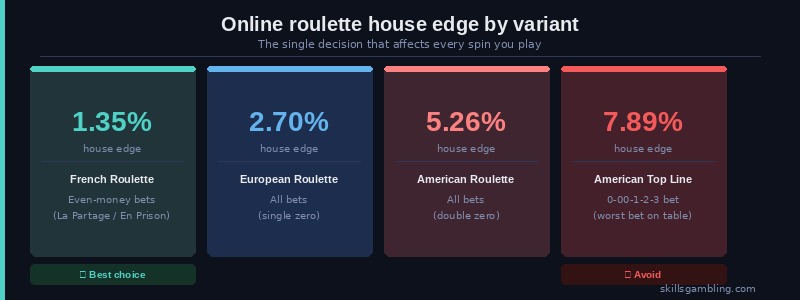
Every player should understand these three variants before placing a single chip. They are not interchangeable. The difference between them is the difference between playing a reasonable game and an expensive one.
European Roulette
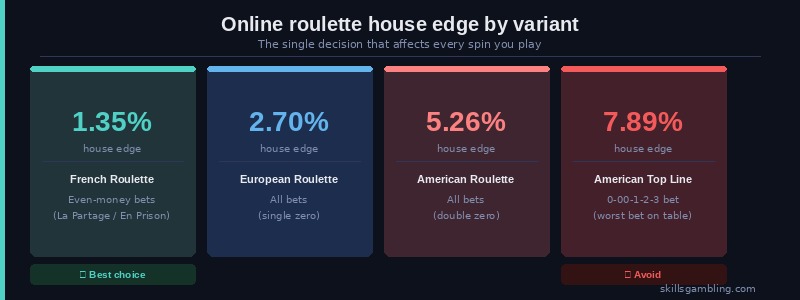
The standard. Single zero wheel, 37 pockets, house edge of 2.70% on all bets. This is the default version at virtually every online casino and the baseline against which other variants are measured. If you’re looking for a quick roulette session with no special rules or features, this is the correct game to choose.
American Roulette
The expensive version. Double zero wheel, 38 pockets, house edge of 5.26% on all standard bets. The payouts are identical to European Roulette. The extra pocket is pure cost. The only bet unique to American roulette — the five-number “top line” covering 0, 00, 1, 2, and 3 — carries a house edge of 7.89%, making it the worst standard bet on any roulette table.
There is no scenario where American roulette is the mathematically preferable choice over European or French roulette. None.
The question isn’t whether to play it — it’s whether you have better options available. If you’re sitting at a physical casino in the United States where the only option is double-zero wheels, you’re playing American roulette. Online, you always have a choice.
French Roulette
The best version for even-money bettors. Single zero wheel — identical to European — but with two additional rules that reduce the house edge on even-money bets by half.
La Partage: If the ball lands on zero, even-money bets (Red/Black, Odd/Even, High/Low) lose only half their stake rather than the full amount. House edge on even-money bets: 1.35%.
En Prison: An alternative to La Partage. If the ball lands on zero, even-money bets are “imprisoned” for one more spin rather than losing immediately. If the next spin wins, the stake is returned in full. Mathematically equivalent to La Partage over large samples. House edge on even-money bets: 1.35%.
Non-even-money bets in French roulette carry the standard European 2.70% house edge — La Partage and En Prison only apply to even-money wagers.
| Variant | Pockets | House Edge (standard) | House Edge (even money) | RTP |
|---|---|---|---|---|
| French Roulette | 37 | 2.70% | 1.35% | 98.65% |
| European Roulette | 37 | 2.70% | 2.70% | 97.30% |
| American Roulette | 38 | 5.26% | 5.26% | 94.74% |
| American (top line) | 38 | 7.89% | — | 92.11% |
“The single best roulette decision you’ll ever make costs nothing: choosing French over American before you spin.”
The Roulette House Edge Explained
The house edge is the mathematical reason the casino makes money from roulette over time. Understanding it precisely — not vaguely — is the foundation of every smart decision at the roulette table.
In European roulette, there are 37 pockets. A straight-up bet on a single number pays 35 to 1. If the odds were fair, it would pay 36 to 1 (since 36 numbers lose for every 1 that wins). That one-unit gap is the house’s profit on every straight-up bet.
Mathematically:
House edge = (1 × 1/37) − (35 × 36/37) … simplified = 1/37 = 2.70%
Or more practically: for every £100 wagered on European roulette over many spins, the casino expects to retain £2.70.
In American roulette, 38 pockets. Same 35:1 payout. The house keeps the equivalent of 2/38 = 5.26% of every bet.
The critical insight: the house edge is identical across every standard bet on the same wheel. Whether you bet on a single number, a colour, a dozen, or an even-money outside bet — in European roulette, every bet carries the same 2.70% disadvantage. Understanding how the house edge is built into every casino game explains why this is the starting point for any gambling decision.
The only exceptions are:
- The American top-line bet (0, 00, 1, 2, 3): 7.89% — structurally worse than any other bet on the table
- French even-money bets with La Partage/En Prison: 1.35% — structurally better due to the half-return rule
Everything else on the standard wheel carries the baseline rate for that variant.
What the House Edge Means Over a Session
This is where many players misunderstand the maths. The house edge is a long-run average, not a session guarantee. Over a single evening, variance is enormous. You might play European roulette for three hours and come out ahead. You might play it for one hour and lose heavily. Both outcomes are consistent with a 2.70% house edge.
Variance and its role in skill-based gambling decisions determines short-term results. The house edge determines long-term expectation. Those are different things — and conflating them is the source of most roulette betting system myths.
Every Bet on the Roulette Table — Odds, Payouts, and House Edge
There are two categories of roulette bets: inside bets (higher risk, higher payout) and outside bets (lower risk, lower payout, but identical house edge on the same wheel).
Inside Bets
| Bet | Coverage | Payout | Probability (European) |
|---|---|---|---|
| Straight up | 1 number | 35:1 | 2.70% |
| Split | 2 numbers | 17:1 | 5.41% |
| Street | 3 numbers | 11:1 | 8.11% |
| Corner | 4 numbers | 8:1 | 10.81% |
| Six Line | 6 numbers | 5:1 | 16.22% |
Outside Bets
| Bet | Coverage | Payout | Probability (European) |
|---|---|---|---|
| Column | 12 numbers | 2:1 | 32.43% |
| Dozen | 12 numbers | 2:1 | 32.43% |
| Red/Black | 18 numbers | 1:1 | 48.65% |
| Odd/Even | 18 numbers | 1:1 | 48.65% |
| High/Low | 18 numbers | 1:1 | 48.65% |
Important: All these bets carry the same 2.70% house edge on a European single-zero wheel. The difference between inside and outside bets is variance, not expected value. Straight-up bets produce wilder swings — large wins separated by many losses. Even-money bets are smoother — results hover closer to the theoretical mean.
Called Bets (Announced Bets)
Available at most live and online French/European roulette tables, called bets cover specific sections of the physical wheel rather than the table grid:
Voisins du Zéro (“Neighbours of Zero”): Covers 17 numbers around the zero segment. Requires 9 chips minimum.
Tiers du Cylindre (“Thirds of the Wheel”): Covers 12 numbers on the opposite side of the wheel from zero. Requires 6 chips.
Orphelins (“Orphans”): The 8 numbers not covered by Voisins or Tiers. Requires 5 chips.
Neighbours: A single number plus two numbers on each side of it on the physical wheel. Always 5 chips.
Called bets carry the same house edge as all other European wheel bets — 2.70%. They offer no mathematical advantage but are popular for their aesthetic appeal and the different variance profile they produce.
Live Dealer Roulette Online: What’s Different and What to Look For
Live dealer roulette has transformed online casino gaming. A real wheel, real ball, and professional croupier are streamed in real time from a dedicated studio or a partner land-based casino. Players bet through a digital interface overlaid on the video feed.
Why it matters mathematically: Live roulette uses a physical wheel and ball — the same randomising mechanism as a land-based casino. This eliminates any residual scepticism about RNG software and provides visible, verifiable randomness. The house edge is identical to the stated rules of the game being played.
What distinguishes good live roulette:
Multiple camera angles — at minimum, a wheel overview, a close-up ball-tracking view, and a slow-motion replay of the winning number. Evolution Gaming’s Immersive Roulette pioneered this format.
Statistics panels — live tables typically display hot and cold numbers, last results, and neighbour bet frequency. These statistics are interesting but carry no predictive value — each spin is independent.
Bet-behind functionality — some tables allow additional players to follow the bets of a primary player at a full table. Useful for accessing popular high-limit tables without waiting.
Dual Play tables — Evolution streams certain tables simultaneously from land-based casinos (including the Hippodrome in London and Dragonara in Malta), combining genuine casino atmosphere with online accessibility.
Session length consideration: Live roulette produces approximately 40–50 spins per hour on standard tables, versus 80–120 spins per hour on RNG games. Speed Roulette variants can reach 60–70 spins per hour. Slower pace means less exposure per hour at the same stake level — a meaningful consideration for managing your roulette bankroll.
Modern Live Roulette Variants in 2026
The standard European, French, and American games now share online casino lobbies with a generation of hybrid variants that add multipliers, bonus rounds, and game-show elements. Understanding what these change — and what they don’t — matters before you sit down at one.
Lightning Roulette (Evolution)
The most popular live roulette game in the world. Built on European single-zero rules, but before each spin, 1–5 “Lucky Numbers” are selected at random and given multiplied payouts of 50x to 500x.
The trade-off: straight-up bets on non-multiplied numbers pay only 29:1 instead of 35:1. The reduced base payout funds the occasional multiplier. RTP: 97.10% — slightly below standard European roulette’s 97.30%. The house edge increases marginally but the variance profile changes dramatically: Lightning Roulette produces rare, very large wins and more frequent small losses.
XXXtreme Lightning Roulette (Evolution)
Amplified Lightning. Up to 500x multipliers on Lucky Numbers, with Chain Lightning potentially stacking to 2,000x. Straight-up bets on non-multiplied numbers pay only 19:1. The reduced base payout is significant. RTP: 97.10–97.30% depending on bet mix. Higher variance still — a game for players specifically seeking occasional large payouts rather than session longevity.
Immersive Roulette (Evolution)
Standard European roulette with multi-camera production — including slow-motion ball tracking as the winning number is determined. No rule changes, no multipliers. House edge: 2.70%. The innovation is purely presentational. An excellent choice for players who want standard roulette odds with premium visual experience.
Speed Roulette / Auto Roulette (Evolution, Playtech)
European rules, no multipliers, game rounds of 25 seconds or fewer. Significantly higher spins per hour — Auto Roulette variants can reach 80+ spins per hour. The faster pace increases total exposure per hour at the same stake level. For bankroll management purposes, these variants require proportionally lower stakes per spin to maintain the same hourly risk.
Mega Fire Blaze Roulette (Playtech)
European roulette with a progressive jackpot feature triggered by specific number patterns. The jackpot adds a small positive EV component under the right conditions but the base game RTP reflects the jackpot’s funding cost. Worth understanding the specific RTP structure before playing.
| Variant | Base Rules | House Edge | Key Feature |
|---|---|---|---|
| French Roulette | Single zero | 1.35% (even money) | La Partage / En Prison |
| European Roulette | Single zero | 2.70% | Standard |
| Immersive Roulette | Single zero | 2.70% | Multi-camera production |
| Lightning Roulette | Single zero | ~2.90% | 50x–500x multipliers |
| XXXtreme Lightning | Single zero | ~2.70–2.90% | Up to 2,000x |
| Speed Roulette | Single zero | 2.70% | 25-second rounds |
| American Roulette | Double zero | 5.26% | — |
Betting Systems: What They Do and What They Can’t Do
Every roulette betting system ever invented makes the same implicit promise: that by structuring your bets in a specific pattern, you can overcome the house edge. None of them can. Understanding precisely why takes about two minutes and will save you money for the rest of your life.
The Core Mathematical Truth
The house edge applies to every spin independently. Whatever happened on previous spins has no effect on what will happen next. The wheel has no memory. The ball has no memory. Whether red has appeared nine times in a row or zero times in an hour, the probability of red on the next spin in European roulette is always 18/37 = 48.65%.
A peer-reviewed statistical analysis published by the University of Nevada’s Gaming Institute found that progressive betting systems dramatically increase the variance of outcomes without changing expected value — exactly as the mathematics predicts.
This means no sequence of bets can change the house’s long-run advantage. What betting systems can do is change the distribution of your wins and losses across a session. Some systems produce many small wins and occasional catastrophic losses. Others produce smoother results with a lower ceiling on wins.
Martingale
How it works: Double your bet after every loss. Return to your base bet after a win.
The promise: A single win recovers all previous losses.
The reality: The bet sizes escalate exponentially. Starting at £5: after six consecutive losses, your next bet is £320 to recover £5 net profit. A streak of seven losses — which has approximately a 1-in-106 chance of occurring in European roulette on any given spin — forces a £640 bet. Most tables have maximum bet limits specifically because of this system.
The actual cost: You are not beating the house edge. You are taking a series of negative-EV bets and converting the cumulative loss into an occasional catastrophic session.
D’Alembert
How it works: Increase your bet by one unit after a loss, decrease by one unit after a win.
Less aggressive than Martingale in its escalation. The mathematical result is identical in principle: each bet still carries the house edge. The system produces smoother variance with a lower ceiling on both wins and losses.
Fibonacci
How it works: Bet sizes follow the Fibonacci sequence (1, 1, 2, 3, 5, 8, 13, 21…) after losses.
Slower escalation than Martingale, but still a progressive negative system. A long losing streak still forces uncomfortably large bets. Expected value: unchanged at −2.70% of every pound wagered.
Paroli (Positive Progression)
How it works: Double your bet after a win, for a maximum of three consecutive wins, then return to base.
Different risk profile: You are increasing stakes from winnings rather than after losses. The exposure of your own bankroll is limited. Paroli produces occasional 3-win sequences worth 7× your base stake, with losses limited to your base bet at each reset.
The honest assessment: Paroli is the most bankroll-friendly of the common systems because it limits how much of your own money you put at risk in any single run. The house edge per bet remains 2.70%. It’s a valid choice for managing the entertainment experience of a roulette session — not a method of generating profit.
“Betting systems don’t change the house edge. They change how quickly or slowly you lose to it — and sometimes they make losing more dramatic.”
The One Thing Systems Can Do
A flat betting approach — same stake every spin — is mathematically identical to any progression system in terms of expected value. But psychologically, systems provide structure. For players whose primary goal is entertainment and session management rather than profit, a system like Paroli can make a fixed entertainment budget last longer and feel more controlled.
That’s a legitimate use. Just don’t confuse it with edge.
Where Skill Actually Exists in Roulette
Roulette is primarily a luck-based game. The skill element is narrow — but it is real, and it compounds over time.
Skill Area 1: Game Selection
This is the highest-impact decision a roulette player makes. Choosing French roulette over American roulette on even-money bets reduces your house edge by 74% — from 5.26% to 1.35%. No betting system, no strategy, no insight can produce that magnitude of improvement.
The skill: knowing which variants exist, understanding their house edges, and actively seeking out the best-value game available.
Skill Area 2: Bet Selection Within a Game
On any given wheel, all standard bets carry the same house edge. The skill in bet selection isn’t about finding a “better” bet — it’s about choosing a variance profile that matches your bankroll and session goals.
If you have a small session budget and want to maximise the number of spins, even-money outside bets provide the smoothest results — you win or lose in small increments, which extends your playing time. If you have a larger bankroll and want the possibility of a significant win, inside bets on individual numbers deliver that at the cost of more variance.
The skill is matching your bet type to your session structure. Expected value in gambling explains the maths behind why this trade-off doesn’t change the long-run economics — only the distribution of outcomes.
Skill Area 3: Avoiding Negative Variance Traps
Certain bets and certain situations are straightforwardly worse than the baseline. The American top-line bet at 7.89% is the clearest example. The 6:5 table in live dealer variants (rare, but exists) is another. Knowing which bets to avoid is a real, applicable skill.
Skill Area 4: Bankroll Management
How disciplined bankroll management protects your gambling decisions is the most transferable skill in all forms of gambling, including roulette. Specific to roulette:
- Session loss limit: Set it before you sit down. The ability to leave when you hit it is a skill.
- Stake sizing relative to bankroll: At 2.70% house edge with typical variance, a conservative player bets no more than 1–2% of their session budget per spin.
- Game speed awareness: Auto Roulette producing 80+ spins per hour at the same stake as a standard table is materially different risk exposure. Reducing stake proportionally on faster variants is intelligent bankroll management.
Where Skill Does NOT Exist
- Predicting where the ball will land
- Finding “hot” or “due” numbers
- Using previous spin results to inform future bets
- Betting systems that claim to overcome the house edge
- Any system claiming to “beat” roulette mathematically
The Roulette Myths That Cost Players Money
Myth 1: Numbers Are “Due”
The Gambler’s Fallacy — the belief that a random outcome becomes more likely after a long absence — is one of the most extensively documented cognitive errors in gambling psychology. Peer-reviewed research on the gambler’s fallacy confirms it affects experienced and inexperienced gamblers alike.
In practice: if number 17 hasn’t appeared in 50 spins, the probability of it appearing on spin 51 is exactly 1/37. The wheel has no memory. The balls trajectory is determined by physics at the moment of each spin, not by what happened previously.
Myth 2: Watching the Wheel Reveals Patterns
Some players track results, note “hot” and “cold” numbers, and adjust their bets accordingly. Modern roulette wheels — both physical and online — are manufactured to extraordinary precision. Certified physical wheels are balanced to eliminate any detectable mechanical bias. RNG wheels produce statistically independent results by design, verified by independent testing laboratories. In a properly maintained environment, no pattern exists to find.
Myth 3: Live Dealer Roulette Can Be Beaten By Timing
The belief that human dealers have predictable release points or ball speeds that can be exploited is occasionally true in poorly maintained land-based casinos with worn equipment. In online live dealer environments, Evolution and other major providers use precision-engineered auto-release mechanisms and rotating dealer schedules specifically to eliminate any such pattern. In 2026, this edge does not exist in practice at reputable online casinos.
Myth 4: Betting Systems Work Long-Term
Addressed above — but worth stating simply: no betting system changes the house edge. The Martingale, Fibonacci, D’Alembert, Labouchère, Oscar’s Grind, and every variation of every progression system produce the same expected loss per unit wagered as flat betting. The mathematics is settled. This is not a matter of opinion or strategy — it is proven.
Myth 5: More Bets = More Chances to Win
Some players cover large portions of the wheel with multiple simultaneous bets — placing chips on red, on a dozen, and on a specific number simultaneously. Covering more numbers increases the frequency of winning spins but decreases the magnitude of each win. The expected value of the combined bet position is the sum of its component bets, each carrying the 2.70% house edge. More bets means more money at risk per spin, not better odds.
How to Choose the Right Roulette Game Online
With dozens of roulette variants in any online casino lobby, the decision framework is simpler than it looks.
Step 1: Identify what’s available. Search the live casino or table games section for French Roulette first. If it’s available with La Partage or En Prison rules, and you plan to bet primarily on even-money outcomes, this is your highest-value option at 1.35%.
Step 2: If French isn’t available, choose European. Single zero, 2.70%, no special rules. This is always preferable to American.
Step 3: Avoid American Roulette unless it’s the only option. The double zero adds approximately 2.56 percentage points of house edge. Over a typical session of 100 spins at £10 per spin, the expected additional cost of American over European is £25.60. That’s not trivial.
Step 4: Decide on RNG vs live dealer. If the house edge matters to you — and it should — both RNG and live dealer versions of the same variant carry identical theoretical edges. The choice is about experience: RNG is faster, can be played in demo mode, and has no minimum bet restrictions. Live dealer is slower, more immersive, and requires real-money play.
Step 5: Check the specific RTP of any variant. Lightning Roulette’s slightly reduced RTP (97.10% vs 97.30%) is a small but real cost for the multiplier entertainment. Make that trade consciously, not by accident.
Bankroll Management for Roulette Players
Roulette’s house edge is fixed, which makes bankroll management the primary lever available to a player. The question isn’t how to eliminate the edge — it’s how to structure your play to survive variance, enjoy the experience, and avoid losing more than intended.
Set a Session Budget Before You Open the Game
Decide the maximum you’ll lose in this session before you sit down. This is not the same as your deposit balance. It’s the amount you’re willing to spend for the entertainment of playing. Once it’s gone, the session ends.
This sounds obvious. It isn’t obvious in practice, because variance means you might be significantly up at some point during a losing session — and the temptation to “play back to even” after a loss, or “while you’re ahead” after a win, is powerful. A predetermined hard limit removes that decision from the equation.
Stake Size Relative to Session Budget
A sensible starting point for roulette players:
- Conservative: 1% of session budget per spin (100-spin cushion)
- Moderate: 2% of session budget per spin (50-spin cushion)
- Aggressive: 5% of session budget per spin (20-spin cushion)
At 2.70% house edge in European roulette, the expected loss per 100 spins at 2% stake sizing is approximately 5.4% of your session budget. The variance around that expectation is large — you might win 20%, or lose 30%. The point is survivability: enough spins to let the session develop rather than going broke in the first twenty minutes.
Game Speed Matters
At 40 spins per hour on a standard live table versus 80+ on Auto Roulette, the same stake per spin doubles your hourly theoretical loss on the faster game. If you switch to Speed or Auto variants, either accept the higher hourly exposure or halve your stake.
Win Targets: Optional But Useful
Setting a win target — “I’ll stop playing if I’m up 50% of my session budget” — is psychologically useful because roulette variance means you will be in profit at some point during most sessions. The ability to leave while ahead requires the same discipline as leaving after a loss. Neither is more natural; both require a prior commitment.
Responsible Gambling
No roulette strategy, betting system, or variant selection guarantees a profit. All roulette involves financial risk. The house edge means that over sufficient spins, the mathematical expectation is a loss.
The decisions that skill influences — game selection, bet sizing, bankroll management — reduce how much you lose to the house edge. They do not eliminate it.
Signs That Gambling Is Becoming Harmful
- Playing with money you cannot afford to lose
- Chasing losses — playing longer or raising stakes to recover what you’ve lost
- Borrowing money to gamble
- Gambling interfering with work, relationships, or other obligations
- Finding it difficult to stop once you’ve started
These are not signs of bad strategy. They are signs that gambling has shifted from entertainment to a problem — and no strategy guide addresses that. Please use the resources below.
Support Resources
- GamCare (UK): gamcare.org.uk / 0808 8020 133 (free, 24/7)
- BeGambleAware: begambleaware.org
- GAMSTOP (UK self-exclusion): gamstop.co.uk
- Gamblers Anonymous: gamblersanonymous.org.uk
- National Problem Gambling Helpline (US): 1-800-522-4700
FAQ
What is the best roulette variant to play online?
French Roulette with La Partage or En Prison rules offers the lowest house edge of any standard roulette game — 1.35% on even-money bets. If French is unavailable, European Roulette (2.70%) is the correct second choice. American Roulette (5.26%) should be avoided whenever either of the above is available.
Does it matter which numbers I bet on in roulette?
Mathematically, no. Every number on a European wheel carries the same 2.70% house edge. “Hot” numbers, “cold” numbers, and personal lucky numbers are not meaningful statistical categories. What matters is the type of bet (inside vs outside) for variance management purposes — not the specific numbers chosen.
Can any strategy beat the house edge in roulette?
No. The house edge is built into the relationship between the probability of winning and the payout offered. No betting system — including the Martingale, Fibonacci, D’Alembert, or any other progressive system — can change that mathematical reality. Strategies change the distribution of wins and losses; they do not change the expected value per pound wagered.
Is live dealer roulette fair?
Yes — at licensed, regulated online casinos. Live dealer roulette uses physical wheels and balls, which are manufactured to certified precision standards. The randomness is verifiable — players can watch every spin in real time. Major providers like Evolution Gaming are audited by independent testing laboratories and regulated by multiple gaming authorities including the UK Gambling Commission and the Malta Gaming Authority.
What is La Partage and En Prison?
Both are rules specific to French Roulette that apply when the ball lands on zero. La Partage returns half your stake on even-money bets. En Prison holds your stake for one more spin, returning it in full if the next spin wins. Both reduce the house edge on even-money bets from 2.70% to 1.35%. A table typically offers one or the other, not both simultaneously.
What is the house edge on Lightning Roulette?
Lightning Roulette carries a house edge of approximately 2.90% — slightly higher than standard European roulette (2.70%). The higher edge reflects the funding mechanism for the 50x–500x multiplier payouts. The RTP is approximately 97.10%. Worth playing if the entertainment value of multipliers appeals to you; not worth playing if your priority is minimising house edge.
How many spins per hour does live roulette produce?
Standard live dealer tables produce approximately 40–50 spins per hour. Speed Roulette increases this to around 60–70 spins per hour. Auto Roulette (no live dealer) can reach 80+ spins per hour. Higher spins per hour means more exposure at the same stake — a relevant factor in session bankroll planning.
Is roulette a game of skill or luck?
Primarily luck. The outcome of each spin is determined by physics (live) or certified RNG (online) — neither of which is influenced by player decisions. The limited skill elements are: game selection (choosing the lowest house edge variant), bet selection (matching variance to bankroll), and bankroll management (controlling stake sizing and session exposure). These decisions are meaningful over time but do not alter the fundamental randomness of each spin.
Conclusion
Online roulette in 2026 is a richer, more varied, and more accessible game than it’s ever been — from standard European tables to live-streamed Lightning Roulette with thousand-times multipliers. The fundamentals, though, have not changed since Blaise Pascal’s wheel began spinning in 17th-century France.
The house edge is fixed. It applies to every spin. No system changes it.
What you control is everything around the spin: which game you choose, which bets you place, how much you stake, and when you stop. Those decisions, made consistently, represent the totality of skill available in roulette — and they are worth making carefully.
The order of priority is clear:
- Choose French Roulette first. 1.35% on even-money bets is the best standard roulette house edge available. Nowhere else can a single menu selection save you this much per session.
- Choose European over American. Always, whenever the option exists.
- Understand what you’re buying with Lightning Roulette and variants. A slightly higher house edge in exchange for the possibility of very large multipliers. A conscious trade, not a free upgrade.
- Manage your bankroll as precisely as your game selection. The best variant choice in the world is undone by stake sizing that wipes out your session budget in twenty spins.
Roulette is honest entertainment. The wheel doesn’t pretend the odds are in your favour. Play it for what it is — a visually compelling, mathematically transparent game where the outcome of each spin is beyond your control — and the decisions surrounding it are entirely within it.
Related Reading
- How the House Edge Is Calculated Across Every Casino Game
- Expected Value: The Concept That Changes How You Approach Every Bet
- Bankroll Management: The Strategy That Protects Every Other Strategy
- Skill vs Luck: What Actually Determines Your Results
- Can Skill Ever Overcome the House Edge?
- How Professional Gamblers Think Differently
- Blackjack Basic Strategy Chart: The Definitive Guide
SkillsGambling.com is an educational resource. Nothing published here constitutes financial advice or a guarantee of gambling outcomes. Gambling involves financial risk. Please gamble responsibly. 18+ only.