
Reading time: ~25 minutes | Last updated: June 2026
Quick Answer: Online blackjack is the most skill-friendly game in any casino — digital or live. Player decisions directly influence mathematical outcomes, and the difference between good and poor decisions is measurable in percentage points of house edge. With perfect basic strategy, the house edge in a well-structured online blackjack game drops to 0.4–0.6% — among the lowest of any casino game. Without it, you’re giving the house 2–4% on every hand. This guide covers how online blackjack works, which variants offer the best conditions, how to find the right tables, and the decision-making framework that separates informed players from everyone else.
Table of Contents
- How Online Blackjack Works
- RNG Blackjack vs Live Dealer Blackjack
- The House Edge in Online Blackjack — and What Moves It
- Rule Variations: How Table Rules Affect Your Odds
- Online Blackjack Variants Explained
- Live Dealer Blackjack in 2026
- Basic Strategy: The Foundation of Every Good Decision
- Beyond Basic Strategy: Advanced Techniques
- Side Bets: What They Are and Why to Avoid Most of Them
- How to Choose the Right Online Blackjack Table
- Bankroll Management for Online Blackjack
- Common Mistakes That Cost Players Money
- Responsible Gambling
- FAQ
- Conclusion
How Online Blackjack Works
Online blackjack follows the same rules as the casino floor game that’s been played for centuries. The objective is simple: build a hand value closer to 21 than the dealer’s, without exceeding it.
Card values:
- Number cards (2–10): face value
- Face cards (Jack, Queen, King): 10
- Ace: 1 or 11, whichever is more favourable
How a hand plays out:
You place your bet before any cards are dealt. You and the dealer each receive two cards — yours face up, the dealer’s with one face up and one face down. You then make a decision: hit (take a card), stand (take no more cards), double down (double your bet and take exactly one more card), split (if you have a pair, divide into two hands), or surrender (give up half your bet and exit the hand, where available).
After you’ve acted on your hand, the dealer reveals their hole card and plays to a fixed rule: hit until reaching 17 or higher (or in some variants, stand on all 17s including soft 17). The better hand wins; equal totals are a push (tie).
What makes blackjack different from most casino games is that your decisions genuinely matter. The game is not purely random. Every hit, stand, double, or split has a mathematically correct answer based on your hand and the dealer’s upcard. Making those correct decisions — consistently, every hand — is what basic strategy quantifies and teaches.
RNG Blackjack vs Live Dealer Blackjack
Online blackjack exists in two fundamentally different formats. Understanding the distinction is the first practical decision any player faces.
RNG Blackjack
RNG (Random Number Generator) blackjack is software-based. Each hand is dealt by an algorithm that produces statistically independent, certified-random outcomes. There are no physical cards, no dealer, no shoe.
Advantages:
- Available 24/7 with no seat limitations
- Play at your own pace — no time pressure on decisions
- Demo mode available — practice for free before risking money
- Minimum bets typically very low (£0.10–£1 at most operators)
- Consult a strategy chart openly without social pressure
Limitations:
- No physical interaction — less atmosphere than live play
- Some players distrust RNG despite independent certification
- Card counting impossible — the deck is reshuffled on every hand
Live Dealer Blackjack
Live dealer blackjack streams real tables, real cards, and professional dealers in real time from dedicated studios. You bet through a digital interface overlaid on the video feed — but the game mechanics are physical.
Advantages:
- Visible, verifiable randomness — you watch every card dealt
- Social interaction with dealers and other players
- Atmosphere closer to a land-based casino experience
- Multiple camera angles and replay features at premium tables
Limitations:
- Minimum bets typically higher (£5–£25 at most tables)
- Game speed dependent on other players’ decisions
- No demo play — real money only
- Strategy cards cannot be consulted as comfortably mid-hand
Which to choose: if you’re learning, developing strategy, or want to practise without stakes pressure, RNG is better. If you want the closest digital approximation of casino play with visible game integrity, live dealer is preferable. The house edge is identical for the same variant in both formats.
The House Edge in Online Blackjack — and What Moves It
The house edge in online blackjack is not fixed. It shifts based on two variables: the rules of the specific game and the quality of your decisions.
This makes blackjack unusual among casino games. Most casino games have a fixed, unavoidable house edge — you can’t reduce it by playing better. In blackjack, you can. The range of possible house edges across different games and play styles:
| Play Style | Typical House Edge |
|---|---|
| No strategy (intuitive play) | 2.0–4.0% |
| Basic strategy (optimal decisions) | 0.4–0.6% |
| Basic strategy + favourable rules | 0.3–0.5% |
| Card counting (optimal conditions) | −0.5% to −1.0% (player edge) |
The jump from intuitive play to basic strategy — roughly 2–3.5 percentage points — is one of the largest skill-driven improvements available in any casino game. It costs nothing except the time to learn the strategy.
Understanding how the house edge is calculated in casino games provides the mathematical foundation for why these numbers matter over any significant volume of play.
What Moves the House Edge
Two categories of factors determine the house edge in any specific game:
Rule-based factors (set by the casino, visible before you sit down):
- Blackjack payout (3:2 or 6:5)
- Number of decks
- Dealer hits or stands on soft 17
- Double down restrictions
- Surrender availability
Decision-based factors (determined by your play):
- Whether you follow basic strategy on every hand
- Correct splitting decisions
- Correct doubling decisions
- Correct surrender decisions where available
The combination of both categories determines your actual expected loss per unit wagered. A player using perfect basic strategy at a table with terrible rules can face a higher house edge than a mediocre player at a table with excellent rules.
Rule selection is itself a skill — and it happens before you play a single hand.
Rule Variations: How Table Rules Affect Your Odds
This is the most practically important section of this guide for online blackjack players. Rule differences between tables are often invisible at a glance but have substantial mathematical consequences.
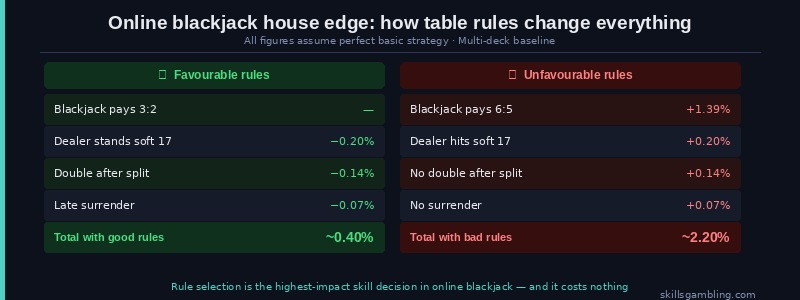
Blackjack Payout: The Most Important Rule
3:2 vs 6:5 is the single most impactful rule in online blackjack.
When you’re dealt a natural blackjack (Ace + 10-value card), the standard payout is 3:2 — a £10 bet returns £15 profit. Many online games, particularly lower-stakes tables and side-bet-heavy variants, pay 6:5 — that same £10 bet returns only £12 profit.
The house edge impact: +1.39% in the casino’s favour from a single rule change.
In practical terms: over 100 hands at £10 per hand, the 6:5 game costs you approximately £13.90 more than the 3:2 game, before any other factor is considered.
Never play 6:5 blackjack when a 3:2 table is available. This rule alone determines whether a game is worth playing.
Deck Count
| Decks | Effect on House Edge |
|---|---|
| Single deck | −0.48% (vs 6-deck baseline) |
| Double deck | −0.19% |
| 4 deck | −0.06% |
| 6 deck | Baseline |
| 8 deck | +0.02% |
Single-deck games appear favourable but are often paired with restrictive rules (6:5 payout, no doubling after split) that eliminate the advantage. Always assess the complete rule set, not individual rules in isolation.
Dealer Soft 17 Rule
S17 (Dealer Stands on Soft 17): better for the player. House edge reduced by ~0.20% compared to H17.
H17 (Dealer Hits Soft 17): worse for the player. More common online. The dealer hitting soft 17 creates more bust opportunities for the dealer but also more strong hands — net effect is unfavourable for the player.
Doubling Down Rules
- Double on any two cards: standard and favourable
- Double on 9, 10, 11 only: restricts your most profitable doubles — adds ~0.09% house edge
- Double on 10, 11 only: more restrictive — adds ~0.18%
- Double after split (DAS) allowed: reduces house edge ~0.14%
Surrender
Late surrender (available after dealer checks for blackjack) reduces the house edge by approximately 0.07–0.08% when used correctly. Not available at all tables. Always use it when available on the hands where basic strategy prescribes it.
Rule Comparison Table
| Rule | Effect on House Edge |
|---|---|
| Blackjack pays 6:5 (not 3:2) | +1.39% |
| Dealer hits soft 17 (vs stands) | +0.20% |
| No double after split | +0.14% |
| Double on 10–11 only | +0.18% |
| No surrender | +0.07% |
| Single deck (with fair rules) | −0.48% |
| Late surrender available | −0.07% |
Total swing between the best and worst common rule combinations: approximately 2% — larger than most players realise and entirely within your control to avoid.
Online Blackjack Variants Explained
Beyond the core game, online casinos offer a range of blackjack variants — from minor rule adjustments to substantially different games. Knowing which are worth playing (and which aren’t) matters.
Classic / Standard Blackjack
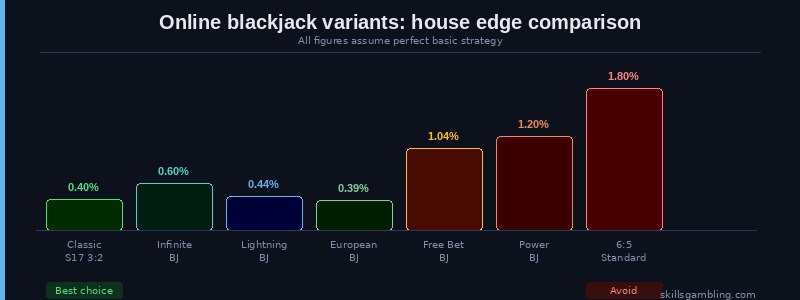
Six or eight decks, standard rules. Your benchmark. Everything else should be compared against it. If the house edge on a variant exceeds standard blackjack under basic strategy, you need a specific reason to play it.
European Blackjack
Played with two decks. The dealer receives only one card initially — the hole card is not dealt until after players have acted. This rule (called no hole card) means the dealer cannot check for blackjack, and players can lose doubled or split bets to a dealer blackjack. Slightly worse for the player in certain spots. House edge approximately 0.39% under optimal play with full rules.
Multihand Blackjack
Play 2–5 hands simultaneously against the same dealer upcard. The house edge per hand is identical to single-hand play. Total expected loss per round increases proportionally — five hands at £5 carries the same expected loss as one hand at £25. Useful for volume and practising decision-making across different hand types simultaneously.
Free Bet Blackjack
The casino pays for your doubles and splits on qualifying hands (hard 9, 10, 11 and non-ten pairs). Sounds favourable — but if the dealer busts with 22 instead of a standard bust, all non-blackjack bets push. This rule change offsets the free doubles and splits. House edge: approximately 1.04%, higher than well-played standard blackjack.
Lightning Blackjack (Evolution)
Standard blackjack with a 100% Lightning Fee added to every bet — effectively doubling your cost per hand. In return, winning hands receive guaranteed multipliers of 2x–25x on the next winning hand. The multiplier doesn’t apply to the hand that earned it; it carries forward.
RTP: approximately 99.56% (house edge ~0.44%) under basic strategy. Slightly above standard multi-deck blackjack due to the Lightning Fee funding mechanism. The variance profile is significantly higher — long runs without large multipliers are common. Play it for the multiplier entertainment, not for edge improvement.
Infinite Blackjack (Evolution)
Unlimited players share the same two-card hand dealt by the dealer. Each player then makes their own independent decisions from that shared starting point. Six Card Charlie rule applies (six cards without busting pays automatically). Four side bets available.
House edge: approximately 0.60% under basic strategy — comparable to standard blackjack. The Six Card Charlie rule provides a small player benefit. This is one of the better-value live variants because it always has an open seat and maintains standard house edge.
Power Blackjack (Evolution)
Eight decks with 9s and 10s removed. Players can Double, Triple, or Quadruple Down on any two initial cards. The deck composition change (fewer 9s and 10s) significantly alters strategy from standard blackjack. RTP: approximately 98.80%. The removal of 9s and 10s hurts the player more than the enhanced doubling options help. House edge roughly 1.2% — notably higher than standard blackjack.
Speed Blackjack (Evolution)
Standard European rules with a twist: when the action phase begins, all players make their decisions simultaneously. First to decide gets the first available card from the shoe. No waiting for slower players. Produces significantly more hands per hour — approximately 20–30% faster than standard live blackjack. House edge unchanged from the underlying rules.
| Variant | House Edge (basic strategy) | Notes |
|---|---|---|
| Classic Blackjack (S17, DAS, surrender) | ~0.40% | Benchmark |
| Infinite Blackjack | ~0.60% | Good live option |
| European Blackjack | ~0.39% | No hole card — strategy adjustments needed |
| Lightning Blackjack | ~0.44% | Higher variance, entertaining |
| Free Bet Blackjack | ~1.04% | 22-push rule erodes free bet advantage |
| Power Blackjack | ~1.20% | Removed 9s/10s hurt more than triple/quad down helps |
| 6:5 Standard Blackjack | ~1.80%+ | Avoid entirely |
Live Dealer Blackjack in 2026
Live dealer blackjack has become the dominant premium format online. Evolution Gaming leads the market — their tables are available at virtually every major licensed online casino — with Playtech and Pragmatic Play Live offering alternative options at some operators.
What Good Live Blackjack Looks Like
Multiple camera angles — at minimum, a wide table view and a close-up card reveal. Slow-motion replays on dealt hands are standard at Evolution tables and help verify outcomes.
Bet Behind — when all seats are occupied, most live tables allow unlimited additional players to bet behind an active player’s hand. Useful for accessing popular tables without waiting.
Pre-Decision and Deal Now — features that allow players to make decisions in advance (if your strategy is clear given the upcard) or request immediate dealing when ready, speeding up the game.
Side bet options — Perfect Pairs and 21+3 are available at most Evolution tables. Their presence doesn’t affect the main game house edge. Their house edges (see Side Bets section) mean most informed players skip them.
Speed and Volume
Standard live blackjack produces approximately 40–60 hands per hour depending on table occupancy. Speed Blackjack reaches 60–80 hands per hour. Infinite variants with no seat limits tend to run at a consistent pace regardless of player count.
Higher hands per hour means more exposure to the house edge per unit time at the same stake. If session length matters, standard tables at lower stakes protect your bankroll more effectively than speed variants at the same stake.
VIP and High-Limit Tables
Evolution’s Salon Privé and similar high-limit environments offer private tables with limits starting at £500–£1,000 per hand. Dedicated VIP service, choice of dealer, and control over game speed. House edge identical to standard tables — the premium is atmosphere and service, not mathematical advantage.
Basic Strategy: The Foundation of Every Good Decision
Basic strategy is the mathematically correct decision for every possible combination of your hand and the dealer’s upcard. It was derived by computer simulation across hundreds of millions of hands and represents the highest-EV play available without card counting.
Playing perfect basic strategy reduces the house edge to approximately 0.4–0.6% on a standard multi-deck game. Playing intuitively — hitting 16 against a 7 because it “feels” right, standing on soft 18 against a 9 because 18 seems good — costs 1.5–3.5 additional percentage points of house edge per session.
The core principles:
Hard hands:
- Always stand on hard 17+
- Always hit hard 8 or less
- Stand on hard 12–16 against dealer bust cards (2–6); hit against dealer power cards (7–Ace)
- Double hard 10 or 11 against most dealer upcards
Soft hands:
- Never stand on soft 17 or less — you cannot bust and standing sacrifices improvement opportunities
- Soft 18 vs dealer 9, 10, Ace — hit; do not stand
- Double soft hands against dealer bust cards (3–6) when appropriate
Pairs:
- Always split Aces and 8s — no exceptions
- Never split 10s or 5s
- Situational splits for other pairs based on dealer upcard
Surrender:
- Surrender hard 16 vs dealer 9, 10, Ace when available
- Surrender hard 15 vs dealer 10
For the complete interactive chart with every decision mapped and explained, see our blackjack basic strategy chart guide. It covers every hand combination with the reasoning behind each decision.
Beyond Basic Strategy: Advanced Techniques
Basic strategy is the ceiling of edge available in most online blackjack environments. Beyond it, a small number of additional techniques apply in specific circumstances.
Composition-Dependent Strategy
Standard basic strategy makes decisions based on hand total — a hard 16 is treated as a hard 16 regardless of which cards make it up. Composition-dependent strategy recognises that 10-6 and 9-7 and 8-8 (before splitting) are not identical in terms of optimal play, because their composition affects the probability of improving.
These deviations are minor in multi-deck games (the large number of remaining cards dilutes composition effects) but more meaningful in single and double deck games. For most online play, the improvement over standard basic strategy is negligible.
Ace Sequencing and Shuffle Tracking
These techniques — tracking groups of cards through imperfect shuffles to predict when aces cluster — are theoretically applicable in live dealer environments. In practice, Evolution and other major providers use continuous shuffling machines (CSMs) or frequent manual shuffles that eliminate the conditions necessary for these techniques to work.
Not a practical consideration for online play.
Card Counting Online
Card counting tracks the ratio of high to low cards remaining in the shoe, allowing players to increase bets when the remaining deck is rich in 10s and Aces (favourable for the player) and decrease bets when it’s depleted of them.
RNG blackjack: card counting is impossible — the deck is reshuffled every hand.
Live dealer blackjack: counting is theoretically possible but extremely difficult and largely impractical for three reasons:
First, penetration (how deep into the shoe the dealer deals before reshuffling) is typically poor online — often only 50–60% of the shoe is dealt before reshuffling, compared to 75–85% in favourable land-based conditions. Low penetration severely diminishes the counter’s edge.
Second, bet spread is limited by table minimum and maximum. Spreading from £5 to £500 — the kind of ratio needed to exploit a high count — is immediately visible and results in rapid reshuffle or table change.
Third, some live tables use continuous shuffling machines, making counting impossible regardless of other conditions.
For practical purposes: the advanced techniques that genuinely move the needle in online blackjack are correct rule selection and perfect basic strategy execution. Research published on arXiv has formalised optimal blackjack betting strategies through dynamic programming, confirming that basic strategy combined with correct stake sizing represents the mathematically provable ceiling of edge available to players without card counting conditions.
For a complete breakdown of what advanced play actually involves at the highest level, see our advanced blackjack strategy guide.
Side Bets: What They Are and Why to Avoid Most of Them
Side bets are additional wagers available alongside the main blackjack game. They’re prominently featured at many live and RNG tables. They’re also, almost without exception, significantly worse value than the main game.
Perfect Pairs
Pays if your first two cards are a pair. Payout varies by type:
- Mixed pair (different suits): 5:1 or 6:1
- Coloured pair (same colour, different suit): 12:1
- Perfect pair (identical suit): 25:1
House edge: approximately 5–8% depending on the specific paytable. This is a slot machine house edge attached to a blackjack table.
21+3
Uses your two cards plus the dealer’s upcard to form a three-card poker hand. Pays for Flushes, Straights, Three of a Kind, Straight Flushes, and Suited Trips.
House edge: approximately 3–5%. Better than Perfect Pairs but still 5–10x worse than the main game.
Hot 3
Pays based on whether your first two cards plus the dealer’s upcard total 19, 20, or 21.
House edge: approximately 4–7% depending on paytable.
Bust It
A bet that the dealer will bust on a specific number of cards. Pays significantly more for a 3-card dealer bust vs a 7+ card dealer bust.
House edge: approximately 6–8%.
Insurance
Available when the dealer shows an Ace. Pays 2:1 if the dealer has blackjack. The implied probability the dealer has blackjack is approximately 30.8% in a six-deck game. A 2:1 payout is only fair at 33.3%+ probability.
House edge on insurance: approximately 7.4% in a six-deck game.
The rule for all side bets: unless you have a specific counted reason to place insurance (which requires active card counting with a significantly positive true count), skip every side bet. The entertainment value they provide costs real money at a rate 5–20x worse than the main game.
How to Choose the Right Online Blackjack Table
Given everything above, the table selection process is straightforward:
Step 1: Confirm 3:2 payout. If the game pays 6:5 on blackjack, leave immediately unless no 3:2 alternative exists anywhere in the lobby.
Step 2: Identify the soft 17 rule. S17 (dealer stands) is better than H17. If both are available, choose S17.
Step 3: Check doubling rules. Double on any two cards is the standard and most favourable. Restrictions add house edge.
Step 4: Confirm surrender availability. Late surrender available — good. Not available — acceptable. Early surrender (before dealer checks for blackjack) — rare and very valuable.
Step 5: Check deck count and penetration. Six or eight decks with good penetration (70%+ of shoe dealt) is standard. Single deck tables usually have offset rules — evaluate the complete rule package.
Step 6: Compare variants. Using the variant table from section 5, select the game offering the lowest house edge under basic strategy among the available options.
The priority order for online table selection:
- 3:2 payout (non-negotiable)
- S17 over H17
- DAS (double after split) allowed
- Surrender available
- Fewest deck restrictions on doubling
A table with all five offers the best achievable house edge online. In practice, you may not find all five — prioritise in order and accept the best available combination.
Bankroll Management for Online Blackjack
Online blackjack’s low house edge (0.4–0.6% under basic strategy) is a mathematical advantage over most casino games. It does not eliminate variance. Session results swing significantly above and below expectation, and proper bankroll management determines whether you survive those swings.
Stake Sizing
A conservative guideline: bet no more than 1–2% of your session budget per hand. With a £100 session budget, this means £1–£2 per hand — enough for 50–100 hands of meaningful play before the session ends.
At 0.5% house edge, the expected loss over 100 hands at £2 per hand is £1.00. The actual result over those 100 hands varies enormously — you might be up £40 or down £50. But the expected long-run cost is genuinely low, which is why stake management matters more here than in higher house-edge games.
Session Speed and Hourly Exposure
Online RNG blackjack can produce 200+ hands per hour if you play quickly. At £2 per hand, that’s £400 in hourly turnover. Even at 0.5% house edge, expected hourly cost is £2 — but variance over 200 hands at that volume is substantial.
Live dealer blackjack at 50 hands per hour at the same stake produces £100 hourly turnover and proportionally less variance. Slowing your play is itself a bankroll management technique.
For the broader principles applicable across all skill-based gambling, bankroll management in gambling covers the full methodology including Kelly Criterion and session structuring.
Win and Loss Limits
Set both before sitting down:
- Loss limit: the session ends when this amount is lost, regardless of circumstances. Non-negotiable.
- Win target: optional but useful — if you’ve won 50% of your session budget, consider stopping. Variance means this favourable position won’t last indefinitely.
Common Mistakes That Cost Players Money
Playing 6:5 Tables
The most expensive single error in online blackjack. The 1.39% additional house edge from 6:5 payouts overwhelms any other factor — better than any betting system, any discipline, or any strategy knowledge. Always check payout before playing.
Taking Insurance
Insurance has a 7.4% house edge. It is never a protection of your winning hand. It’s a separate bad bet. “Even money” on a blackjack against a dealer Ace is insurance by another name — decline it every time without card counting justification.
Ignoring Soft Hands
Standing on soft 17 or soft 18 against strong dealer upcards costs money every time. Soft hands cannot bust on one card. The instinct to protect a “decent” hand by standing is expensive. Follow the chart.
Not Splitting 8s Against Strong Cards
Hard 16 (two 8s) against a dealer 10 is the worst starting position in blackjack. Splitting doesn’t guarantee a win — it likely still loses — but it loses less than playing hard 16. The instinct to not “put more money in” when you’re likely behind is expensive over volume.
Playing Without Reference to Basic Strategy
The gap between intuitive play and basic strategy is 1.5–3.5% of house edge. Over 200 hands at £5 per hand (£1,000 in turnover), this difference is £15–£35 in expected additional losses. Blackjack rewards the players who actually use basic strategy correctly — not the ones who know about it but play “by feel.”
Chasing Losses
Increasing bet sizes after losing hands to recover faster is the most reliable way to accelerate losses. It has no mathematical justification — previous hands have no influence on future hands. The house edge is the same on the next hand whether you’ve just won ten in a row or lost ten in a row.
Responsible Gambling
Online blackjack with basic strategy offers a low house edge — not a player edge. Expected outcomes over any realistic volume of play are still a net loss. No strategy eliminates this.
The low house edge means blackjack costs less per session than most casino games. It does not make it profitable.
Know the Limits of Strategy
Basic strategy tells you the mathematically correct play. It does not guarantee you win. Variance means that even playing every hand perfectly, you will lose sessions, you will lose streaks, and you will occasionally lose substantial amounts in short periods. These are mathematical certainties, not signs that your strategy is wrong.
Recognise Warning Signs
- Increasing stakes after losses to recover
- Playing beyond your predetermined loss limit
- Chasing the “right feeling” rather than following strategy
- Gambling affecting financial responsibilities or relationships
Support Resources
- GamCare (UK): gamcare.org.uk / 0808 8020 133 (free, 24/7)
- BeGambleAware: begambleaware.org
- GAMSTOP (UK self-exclusion): gamstop.co.uk
- National Problem Gambling Helpline (US): 1-800-522-4700
FAQ
Is online blackjack fair?
At licensed, regulated online casinos, yes. RNG blackjack is independently audited by testing laboratories (eCOGRA, iTech Labs, GLI) to verify that outcomes are statistically random and match the stated RTP. Live dealer blackjack uses physical cards and wheels verifiable in real time. Rigging games would destroy operators’ licences and businesses — the house edge gives casinos ample profit without manipulation.
What is the house edge in online blackjack?
The house edge ranges from approximately 0.4% to 4% depending on two factors: the game’s rules and the quality of your decisions. With perfect basic strategy on a standard multi-deck game with 3:2 payout and S17, the house edge drops to approximately 0.4–0.6%. Without strategy, the house edge is typically 2–4%.
Can you beat online blackjack?
Long-run profitability against the house in online blackjack is essentially impossible without card counting conditions that don’t exist online. Basic strategy minimises the house edge to its theoretical floor — it does not flip it to a player edge. Card counting online is impractical due to poor penetration, table limits, and RNG formats. Playing correctly reduces how much you lose; it doesn’t turn blackjack into a profitable activity.
Is live dealer blackjack better than RNG blackjack?
Neither is inherently better. The house edge is determined by the rules, not the format. RNG blackjack is better for learning, low-stakes play, and practising strategy. Live dealer is better for atmosphere, visible randomness, and a more authentic experience. Choose based on your current needs.
What is the difference between S17 and H17?
S17 means the dealer Stands on all soft 17s (including Ace-6). H17 means the dealer Hits soft 17. S17 is better for the player by approximately 0.20% house edge. When choosing between two otherwise identical tables, always choose the S17 game.
Should I ever take insurance in blackjack?
No — unless you are actively card counting and the true count is sufficiently high to justify it (typically count of +3 or higher). For all other players, insurance carries a 7.4% house edge and should be declined every time.
What is Infinite Blackjack and is it worth playing?
Infinite Blackjack is an Evolution Gaming live variant where unlimited players share the same initial two-card hand and make independent decisions. The Six Card Charlie rule (automatic win with six cards without busting) applies. House edge is approximately 0.60% under basic strategy — comparable to standard blackjack. It always has open seats, making it accessible when standard tables are full. A reasonable live choice.
How many hands per hour does online blackjack produce?
RNG blackjack: 150–300 hands per hour (self-paced). Standard live dealer blackjack: 40–60 hands per hour. Speed Blackjack live: 60–80 hands per hour. Higher speed means more hourly turnover at the same stake and proportionally more expected loss exposure.
Conclusion
Online blackjack is the clearest example of skill mattering in a casino game. The difference between knowing basic strategy and not knowing it is measurable in percentage points of house edge — and those percentage points compound across every hand you play.
The framework for playing online blackjack as well as it can be played is not complicated:
- Choose the right game — 3:2 payout, S17, double after split, surrender available. Rule selection is itself a skill and it costs nothing to exercise.
- Learn and apply basic strategy — every hand, every decision, without exception. The blackjack basic strategy chart maps every correct decision.
- Avoid side bets — every side bet carries a house edge 5–15x worse than the main game.
- Manage your bankroll — stake sizing and session limits protect your ability to play correctly without variance forcing decisions you haven’t planned for.
- Understand what strategy achieves — a house edge of 0.4–0.6% is genuinely low. It is not zero. Expected outcomes over any volume of play are still a net loss.
Online blackjack rewards preparation. It rewards consistency. It rewards the player who looks up the correct play rather than going with instinct. That’s a rarer quality than it sounds — and it’s the one that separates the minority who approach online blackjack intelligently from the majority who give back more than necessary to a game that’s already asking very little of them.
Related Reading
- Blackjack Basic Strategy Chart: The Definitive Guide
- Advanced Blackjack Strategy: Techniques for Experienced Players
- How the House Edge Is Calculated Across Every Casino Game
- Bankroll Management: The Strategy That Protects Every Other Strategy
- Expected Value in Gambling: The Complete Guide
- Can Skill Overcome the House Edge?
- Online Roulette: The Definitive Guide to Playing Smarter
SkillsGambling.com is an educational resource. Nothing published here constitutes financial advice or a guarantee of gambling outcomes. Gambling involves financial risk. Please gamble responsibly. 18+ only.