
Reading time: ~14 minutes | Last updated: June 2026
Quick Answer: Backgammon is widely regarded as one of the most skill-intensive games available for real money play online — combining probability calculation, positional strategy, and the doubling cube into a genuine test of ability rather than pure chance. Real-money backgammon platforms exist, though the market is smaller and more fragmented than poker. This guide covers how the game works, where the skill genuinely lives, what the dice probabilities actually are, and what to look for in a legitimate platform before playing for stakes.
Table of Contents
- How Backgammon Is Played
- Backgammon Variants You’ll Find Online
- The Dice Probabilities Every Player Should Know
- Where the Skill Actually Lives
- The Doubling Cube: Backgammon’s Most Distinctive Skill Element
- Is Backgammon Legally a Game of Skill or Chance?
- How to Play Backgammon for Money Online
- What to Look for in a Legitimate Platform
- Backgammon Strategy Fundamentals
- Common Mistakes Beginners Make
- Responsible Gambling
- FAQ
How Backgammon Is Played
Backgammon is a two-player board game played on a board of 24 narrow triangles, called points, divided into four quadrants of six points each. Each player starts with 15 checkers, moving them in opposing directions around the board based on rolls of two dice.
The basic objective: move all 15 of your checkers into your home board, then bear them off — removing them from the board entirely. The first player to bear off all 15 checkers wins the game.
Movement: each turn, a player rolls two dice and moves checkers according to the numbers shown. Rolling doubles (the same number on both dice) grants four moves of that number instead of two. A checker can land on any point that isn’t occupied by two or more of the opponent’s checkers.
Hitting and the bar: if a checker lands on a point occupied by a single opponent checker (called a “blot”), that checker is hit and sent to the bar — effectively starting over. The hit player must re-enter that checker from the bar before making any other move, which can cost significant tempo in a close game.
The board layout: the right half of the board is the home board for each player. The barrier between the two halves is called the bar. Players move their checkers from their opponent’s home board, around the outer board, and into their own home board before bearing off.
Backgammon Variants You’ll Find Online
Most online platforms offer several rule variations beyond the classic game, each changing the strategic calculations involved.
Classic Backgammon: the standard game described above, with checkers starting in their traditional positions (two on the 24-point, five on the 13-point, three on the 8-point, and five on the 6-point for each player).
Acey Deucey: checkers start off the board entirely and must be borne onto the board before play begins normally. Rolling a 1 and a 2 (an “acey deucey”) grants the player the right to play that roll, choose any double to play afterward, and take an additional turn — a powerful and game-changing roll.
Nackgammon: a variant designed by backgammon theorist Nack Ballard, starting with a different checker distribution than classic backgammon, intended to create more contact and a different strategic balance between racing and contact play.
Hypergammon: played with only three checkers per player instead of fifteen, producing dramatically shorter, higher-variance games. Popular in fast online formats and tournaments where game length matters.
LongGammon: all 15 checkers begin on a single point (the 24-point), removing the early positional complexity of classic backgammon in favour of a pure race.
Tavla: the Turkish variant of backgammon, popular across the Balkans and Middle East, with regional rule variations on doubling and starting positions. Common on platforms with significant international player bases.
The Dice Probabilities Every Player Should Know
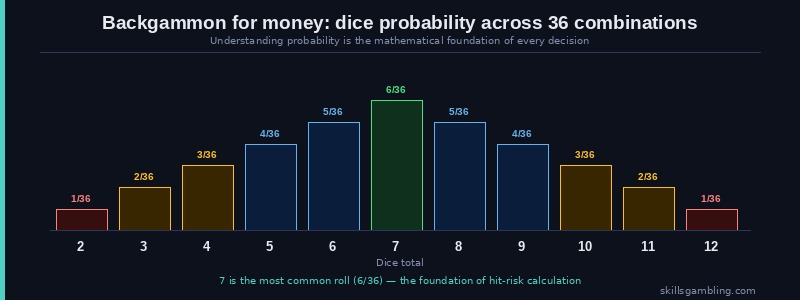
Understanding dice probability is foundational to playing backgammon well — particularly for assessing hit risk, calculating racing odds, and making doubling cube decisions.
With two six-sided dice, there are 36 equally likely outcomes. Here’s how specific numbers occur:
| Roll | Probability | Combinations |
|---|---|---|
| 6-6 (double) | 1/36 | One way |
| 11 (total) | 2/36 | Two 6-5 combinations |
| 5-5 (double) | 1/36 | One way |
| 10 (total) | 2/36 | Two 6-4 combinations |
| 9 (total) | 4/36 | Two 6-3s, two 5-4s |
| 4-4 (double) | 1/36 | One way |
| 8 (total) | 4/36 | Two 6-2s, two 5-3s |
| 7 (total) | 6/36 | Two 6-1s, two 5-2s, two 4-3s |
| 3-3 (double) | 1/36 | One way |
| 6 (total) | 4/36 | Two 5-1s, two 4-2s |
| 5 (total) | 4/36 | Two 4-1s, two 3-2s |
| 2-2 (double) | 1/36 | One way |
| 4 (total) | 2/36 | Two 3-1s |
| 3 (total) | 2/36 | Two 2-1s |
| 1-1 (double) | 1/36 | One way |
Why this matters practically: the probability of rolling any specific double is always 1/36 (2.78%). The probability of rolling doubles in general is 6/36 (16.67%) — meaning roughly one in six rolls produces an extra-tempo double move. Understanding which numbers are most likely (7 is the most common total) helps assess hitting risk and plan checker placement to minimise exposure to your opponent’s most probable rolls.
Where the Skill Actually Lives
Backgammon combines genuine randomness (the dice) with substantial strategic depth. Understanding precisely where skill applies — and where it doesn’t — is the foundation of playing well.
Pip Counting and Racing Decisions
A pip count is the total number of points a player’s checkers need to travel to bear off completely. Calculating and comparing pip counts tells you whether you’re ahead or behind in a pure race, which directly informs whether to play aggressively (contact, hitting) or safely (running, avoiding contact).
Skilled players calculate pip counts quickly and use them to decide whether a position favours racing or fighting — a decision that recreational players frequently get wrong by defaulting to instinct rather than calculation.
Positional Play
Building a prime — six consecutive points occupied by your checkers — traps opposing checkers behind it, since they cannot pass without landing on an occupied point or one with a single vulnerable checker. Constructing and maintaining primes, while avoiding leaving blots exposed to direct hits, is a core strategic skill that separates strong players from weak ones.
Risk Assessment
Every potential move carries a calculable risk of being hit, based on the dice probabilities above. Skilled players weigh the value of an aggressive move (advancing position, hitting an opponent checker) against the probability and cost of being hit in return. This calculation happens dozens of times per game and compounds significantly over a full match.
What Skill Does NOT Change
No amount of skill changes what the dice show on any individual roll. A perfectly played position can still lose to an unfavourable sequence of rolls. This is why skill in gambling activities is best evaluated over many games rather than any single match — the variance in backgammon is real and meaningful, even for world-class players.
The Doubling Cube: Backgammon’s Most Distinctive Skill Element
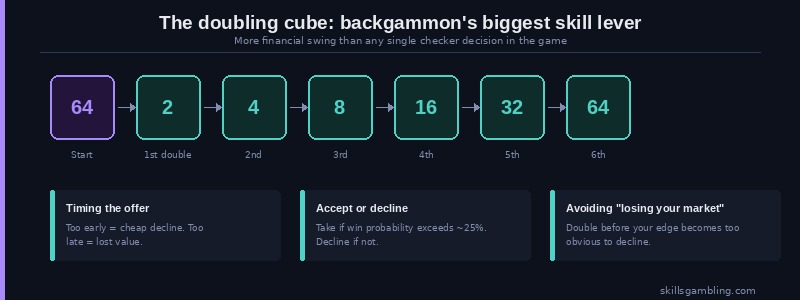
The doubling cube is backgammon’s signature strategic mechanism and arguably where the deepest skill differential between players exists.
How it works: at the start of a game, the cube shows “64” and sits in the middle of the board, available to either player. At any point before rolling, a player who believes they have a significant advantage can offer to double the stakes. The opponent must either accept (taking control of the cube for any future redouble) or decline (conceding the game at the current stake).
Why this is a genuine skill element: correctly timing a double requires assessing your win probability with reasonable accuracy. Doubling too early, when your advantage isn’t yet decisive, gives your opponent a cheap option to decline and limit their loss. Doubling too late means you’ve missed value you could have captured. Taking a double you should have declined — or declining one you should have taken — is one of the most common and costly errors in money backgammon.
The market-losing position: experienced players talk about not wanting to “lose your market” — meaning your win probability becomes so high that your opponent would correctly decline any future double, at which point you can no longer extract additional value from the cube even though your advantage exists. Timing the double before that threshold is reached is a recurring strategic skill.
This is the single biggest financial lever in money backgammon — far more consequential than any individual checker play decision.
Is Backgammon Legally a Game of Skill or Chance?
The legal classification of backgammon has been directly tested in court, and the actual case history is more nuanced than commonly summarised.
In a 1982 New Jersey case, a court examined whether backgammon’s mechanics — including the doubling cube specifically — placed it outside the legal definition of a game of skill. The court found that despite requiring genuine skill, several elements of the game, including the doubling technique, contained gambling characteristics relevant to the state’s gambling regulations.
This sits alongside a broader, more favourable pattern of legal recognition for backgammon as a skill game in other contexts and jurisdictions — courts and commentators widely place backgammon on a skill continuum closer to poker and bridge than to dice games like craps, given the documented and measurable performance gap between strong and weak players over repeated play.
The honest summary: backgammon’s legal status as a skill or chance game is not uniform, and depends on the specific jurisdiction and the specific legal question being asked (gambling regulation, tax treatment, or contract enforceability are all assessed differently). For the broader picture of how skill and chance are legally distinguished across multiple countries, see our guide to skill-based gaming law.
How to Play Backgammon for Money Online
Real-money backgammon exists online, though the ecosystem is considerably smaller and more fragmented than poker’s. Two broad models exist:
Money games: head-to-head matches where each point won or lost has a direct monetary value, often multiplied by the doubling cube throughout the match. This is the closest digital equivalent to traditional backgammon stakes play.
Tournament formats: structured competitions with fixed entry fees and prize pools, often run as single-elimination, round-robin, or Swiss-format events across various time controls.
What’s changed in recent years: several platforms that historically supported direct real-money play have shifted toward coin-based or membership models rather than direct cash stakes, reflecting both regulatory caution and changing platform economics. Players should verify a platform’s current real-money offering directly, as this has shifted meaningfully across the backgammon platform landscape in the past few years — what was true of a given platform even twelve months ago may no longer be accurate.
20BET — Best for Backgammon
Real money matches · Verified fair dice · Worldwide play
18+ · T&Cs apply · Gamble responsibly · begambleaware.org
What to Look for in a Legitimate Platform
Given the smaller and more fragmented nature of the real-money backgammon market compared to poker, platform due diligence matters more here, not less.
Verifiable dice randomness. Reputable platforms use certified random number generators and increasingly offer provably fair mechanisms (some now using blockchain-based verification) that let players independently confirm dice rolls weren’t manipulated. Avoid any platform that doesn’t clearly explain how its randomness is generated and verified.
Clear separation between free and real-money play. Legitimate real-money platforms make the distinction between practice/coin play and actual cash stakes explicit and unambiguous. Platforms that blur this line, or that market “winnings” in non-withdrawable virtual currency as if equivalent to cash, are not real-money gambling platforms regardless of their marketing language.
Jurisdictional transparency. Real-money backgammon availability varies significantly by country and, within countries like the US, by individual state. A legitimate platform will clearly state where real-money play is actually permitted rather than allowing signup from anywhere and leaving compliance ambiguous.
Doubling cube implementation. For money games specifically, verify the platform correctly implements doubling cube mechanics — offer, accept/decline, and redouble (sometimes called “beaver”) functionality. Poor or buggy cube implementation is a red flag for overall platform quality.
Transparent rake or fee structure. Understand exactly what percentage or fee the platform takes from money games or tournament prize pools before committing funds.
This guide deliberately does not recommend specific named platforms, since the real-money backgammon landscape changes meaningfully year to year — platforms that supported cash play recently have moved away from it, and new entrants appear regularly. Verify current real-money availability, licensing, and player reviews directly before depositing funds anywhere.
Backgammon Strategy Fundamentals
Run with strength, hold with weakness. Early in the game, racing checkers forward is generally favoured by strong rolls; holding back and playing a contact-oriented game suits weaker positions where you need time to develop.
Don’t leave unnecessary blots. Every checker left alone on a point is a target. Calculate the probability your opponent can hit it (using the dice probability table above) before accepting that risk for positional gain.
Prioritise the golden point. The five-point (in your home board) is considered the most valuable point to control early in the game — owning it restricts your opponent’s bearing-in options significantly.
Don’t double too aggressively. New players to money backgammon frequently overvalue temporary advantages and double too early, giving opponents an easy decline at minimal cost. Patience with the cube is itself a skill.
Study pip counts as a habit, not an exception. Make pip counting an automatic part of every decision point, not something you calculate only when a position looks close.
Common Mistakes Beginners Make
Playing too passively. New players often avoid contact entirely, racing checkers home without engaging strategically. This surrenders the positional tools (priming, blocking) that create winning chances against stronger dice luck for an opponent.
Misjudging doubling cube decisions. Both over-doubling (offering when the position isn’t strong enough) and under-doubling (failing to capture value when genuinely ahead) are extremely common and directly cost money in stakes play.
Ignoring pip count until forced to. Waiting until a position looks obviously close before calculating pip count means missing earlier opportunities to recognise a clear racing or contact decision.
Treating all blots equally. A blot deep in your home board carries different risk than one in the outer board, because the range of dice rolls that can hit it differs. Beginners frequently fail to distinguish between these risk levels.
Responsible Gambling
No level of backgammon skill eliminates variance from individual games. Real-money backgammon involves genuine financial risk, and even strong players experience losing sessions and losing matches against weaker opponents.
If you’re playing backgammon for money, treat it with the same financial discipline as any other gambling activity: set a budget before you start, never chase losses by doubling stakes to recover, and stop if it stops being enjoyable.
If gambling is affecting your financial wellbeing or relationships, please use these resources:
- GamCare (UK): gamcare.org.uk / 0808 8020 133 (free, 24/7)
- BeGambleAware: begambleaware.org
- National Council on Problem Gambling (US): 1-800-522-4700
FAQ
Is backgammon a game of skill or luck?
Both, in meaningful proportion. Backgammon combines genuine randomness (dice rolls) with substantial strategic depth (positional play, pip counting, doubling cube decisions). Over a single game, luck can dominate — even a strong player can lose to an unfavourable run of dice. Over many games, the skill gap between strong and weak players becomes statistically clear and consistent, similar to poker.
Can you actually make money playing backgammon online?
Yes, if you are genuinely more skilled than your opponents over a meaningful sample of games — but the real-money backgammon ecosystem is considerably smaller than poker’s, with fewer dedicated platforms and a smaller player pool. Profitability depends entirely on consistently outplaying opponents, particularly in doubling cube decisions, over time.
What is the doubling cube in backgammon?
The doubling cube is a six-sided die marked with the numbers 2, 4, 8, 16, 32, and 64, used to track and escalate the stakes of a game. Either player can offer to double the current stake before rolling; the opponent must accept (taking control of future doubling) or decline (conceding the game at the current value). Correct doubling cube timing is one of the most significant skill elements in money backgammon.
Is backgammon legal to play for money?
It depends on jurisdiction. Backgammon has a complex legal history — some courts have recognised it as predominantly a game of skill, while others (including a 1982 New Jersey case) found that elements like the doubling cube carry gambling characteristics relevant to state regulation. Always verify the legal status of real-money backgammon in your specific location before playing.
What is the most important backgammon skill for beginners?
Pip counting and basic doubling cube discipline produce the largest improvement for new players. Understanding when a position favours racing versus contact play, and resisting the urge to double too early or accept a double you should decline, addresses the most expensive recurring mistakes beginners make.
What’s the difference between Classic Backgammon and Nackgammon?
Classic Backgammon uses the traditional checker starting positions. Nackgammon, designed by Nack Ballard, uses a different starting distribution intended to increase early contact between checkers and create a different strategic balance than the classic game. Both use identical core rules for movement, hitting, and bearing off.
Related Reading
- Online Skill Games for Money: Where Ability Actually Wins
- Skill vs Luck in Gambling: What Actually Determines Your Results
- Skill-Based Gaming Law: How Different Countries Define It
- Play Mahjong for Money
- Play Dominoes for Money Online
- Bankroll Management: The Strategy That Protects Every Other Strategy
SkillsGambling.com is an educational resource. Nothing published here constitutes financial or legal advice. Gambling involves financial risk and legal status varies by jurisdiction — always verify local regulations before playing for real money. Please gamble responsibly. 18+ only.